The best answers led us to better questions. It is easy to embrace this notion as just part of the process, learning and all that, and all good. Admittedly, this sentiment may just be comforting fiction. I wasn’t lost. I was exploring. Why admit that we didn’t look far enough ahead and that what was evident Monday morning wasn’t entirely obscure at the start?
Rocket science should avoid wandering, with well-defined questions leading to well-defined answers. But, a well-defined question is not the same as a good question. After enough years, I grew familiar with the pattern. Projects unwrapped their answers, the engine inlet here, the unobtanium over there. These were set aside like shiny new toys. Then we played with the box.
Right now, NASA plans to return to the Moon via SpaceX Starship, a Star Trek Enterprise passing for a Shuttlecraft. As the gargantuan 1960s Apollo program showed, getting there is one thing, but doing so repeatedly and efficiently is something else entirely. So, this time, NASA is looking farther ahead. NASA’s Lunar Exploration and Transportation Services “will secure routine crewed trips from Gateway in lunar orbit to the lunar surface and back.” It seems the search is afoot for better questions.
In the beginning, there was affordability.
The 1990s spawned many launcher concepts competing to cost less up-front and once operational versus the Space Shuttle’s costs. The buzzword then was affordability, though there were many other “-ilities” like reliability, supportability, or maintainability. The failure was all these concepts had fatal flaws. When the concepts were reusable, there was sticker shock over the up-front cost. When expendable, the ideas did little to lower costs in the future. When derived from an existing launcher, there was only a slight improvement over the concept’s origins. When new, the ideas lost credibility on all their predicted costs. Finally, we always seemed to harvest the worse of both worlds when looking between paths. Worse, when fixating on getting to orbit cheaply, better got lost in the fray.
Not to say all was lost. Some projects managed to get some forward momentum. But, by now, along came sustainability. Affordability having devolved from initially being far-term to being more near-term, to no term, for lack of any new funding anyway, sustainability tried to put everyone’s eyes back on the difference. So, rephrasing our answer as a question – how do we get to the finish line sooner and ensure we can keep going?
For low Earth orbit, and with the days of Shuttle flights ending, the notion came around to get cargo to the ISS commercially. Those partnerships and then commercial operations were hugely successful, leading to our post-shuttle capability to get crew to the ISS as well. There was a way to avoid fatal flaws – if the question did not assume NASA owned the system.
Deep space was another beast entirely. With sustainability in mind, a NASA team looked at propellant depots in space in 2011. Again, it was possible to generate concepts balancing factors near and far. Unfortunately, getting these in gear was not as easy. This time, the barrier was obscure. We hit what, in NASA-speak, is a “programmatic” wall. This is a way of saying you can only reduce your costs to the degree your stakeholders allow you to reduce costs.
Apart from programmatic walls, sustainability is not compelling when it is seen as merely a capacity for persisting. Then, even doing more while persisting is not a better answer. As with affordability, what we consider sustainable can also quickly devolve, becoming a continuation of more of the same by another name.
However, in space, the adventure never ends, so we went down a new line of questioning about growth in the 2015 Evolvable Lunar Architecture. Of course, the first steps had to be affordable and sustainable. Here, what should distinguish the first steps is what they would do to foster the next steps. This was no longer just about a cheaper pie or a pie factory; it was about expanding the repertoire of our meals.
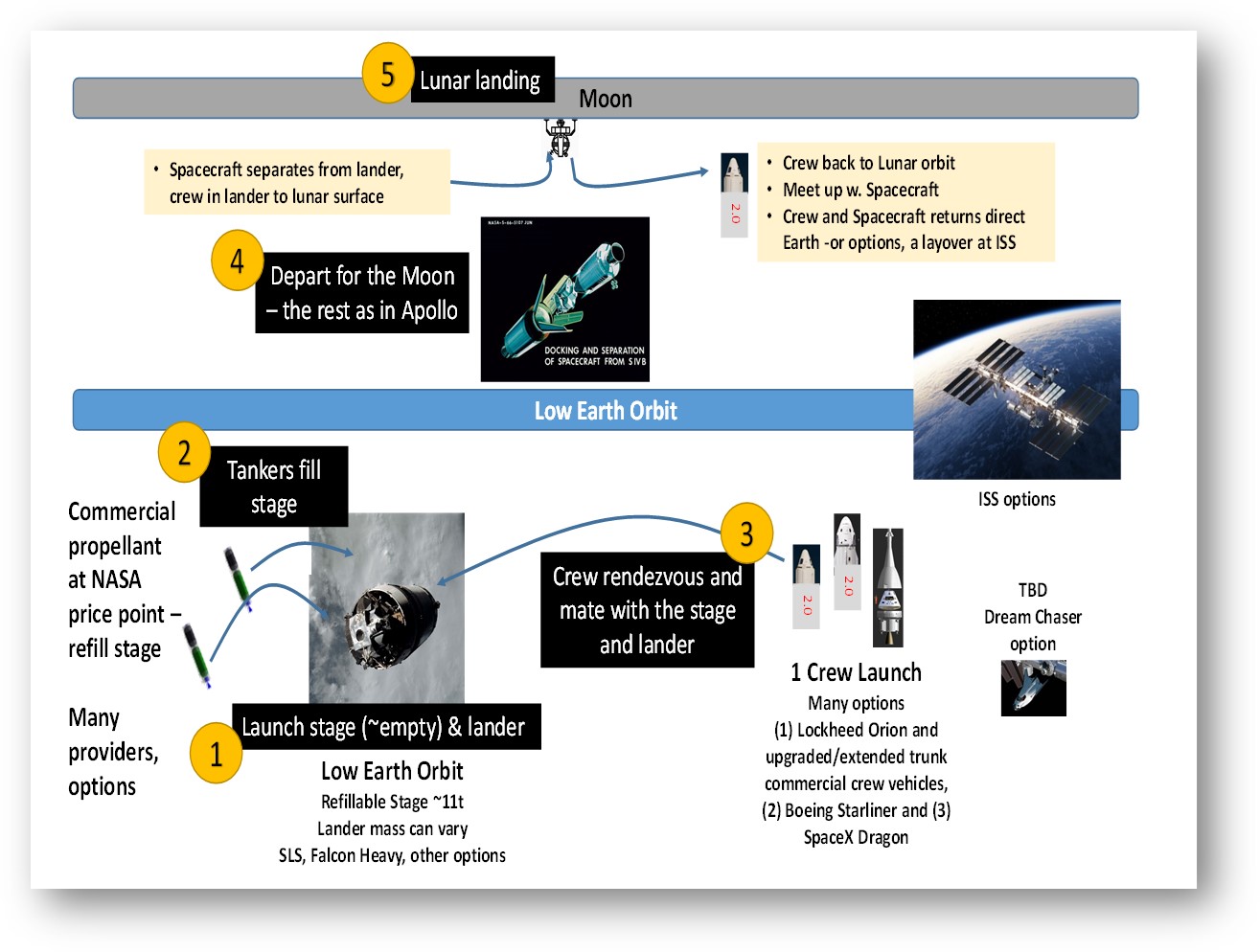
By way of example, a concept derived from the Evolvable Lunar Architecture (and propellant depots) involves refilling the stage departing Earth orbit. Like the Apollo configuration, a lander would already be atop that stage. Spacecraft of many kinds are readily available or can be modified to deliver crew to this ship once it has a full tank. NASA’s search for “LETS” concepts may generate ideas like this, with refueling, refilling, some Earth orbit rendezvous (maybe at the ISS), a layover at a lunar Gateway for a quick meal, or opting for the non-stop ticket to the surface of the Moon. Create new demand, then new supply, then new markets, and before you know it, you might create something surprising.
Yet, at the risk of an imperfect analogy, imagine a forest harvested for lumber. First, the operation wants to be affordable, costing less than the revenue from chopping down trees. Then the process knows it has to adjust, chopping trees no more quickly than they grow. Otherwise, it is not sustainable. Happily, a program comes to replant trees, followed by precisely chopping trees no faster than they grew. This operation is now affordable and sustainable. Plant more, and you increase your haul year over year. We adjust for increasing demand, then pat ourselves on the back.
And still, after all these “ilities” seem resolved, something has been lost in translation. A curated field is no longer a forest. A monopoly can be affordable, sustainable, and meet increasing demand but will also hold back innovation. Yet, being spacefaring would seem to go with possibility, not predictability.
The same motivation that resolves a human need on Earth makes us look up at the night sky in awe and wonder – what’s out there?
If our vision is humans as a spacefaring civilization but plans only go as far as the first steps, we should feel obligated to fill out the middle. After affordability, sustainability, and growth, there is purpose. What joins a near-term plan to a far-off vision? There is a leap of faith where boundless spacefaring visions are half sci-fi dreams and half evolutionary drives. The same motivation that resolves a human need on Earth makes us look up at the night sky in awe and wonder – what’s out there?
That’s not to say a vision of humans as a spacefaring society is inevitable or even possible. There are reasonable arguments where, at best, we end up with something on the Moon or Mars close to our Antarctic research stations, minus the amenities. (Then there is Fermi’s paradox to boot.)
So connecting our next steps to some far-off purpose or vision can only go so far. A healthy, competitive, economic eco-system throughout the solar system is likely unpredictable, more forest than field, with old and new growth in the mix. But, questions reaching beyond affordability, sustainability, and growth, toward purpose, are a start. These are better questions.

 Zapata Talks NASA