The saying “getting your wings clipped” took on a new meaning. It was 2002, and the plan for even a partially reusable replacement for the Space Shuttle now seemed a bridge too far. The debate had already devolved once, from fully reusable to partially reusable. It would devolve again, as all of a sudden, old-style capsules were no longer just the dull part of due diligence. Capsules were suddenly serious contenders. These were crew-carrying capsules, just like the Starliner Boeing will soon launch for NASA.
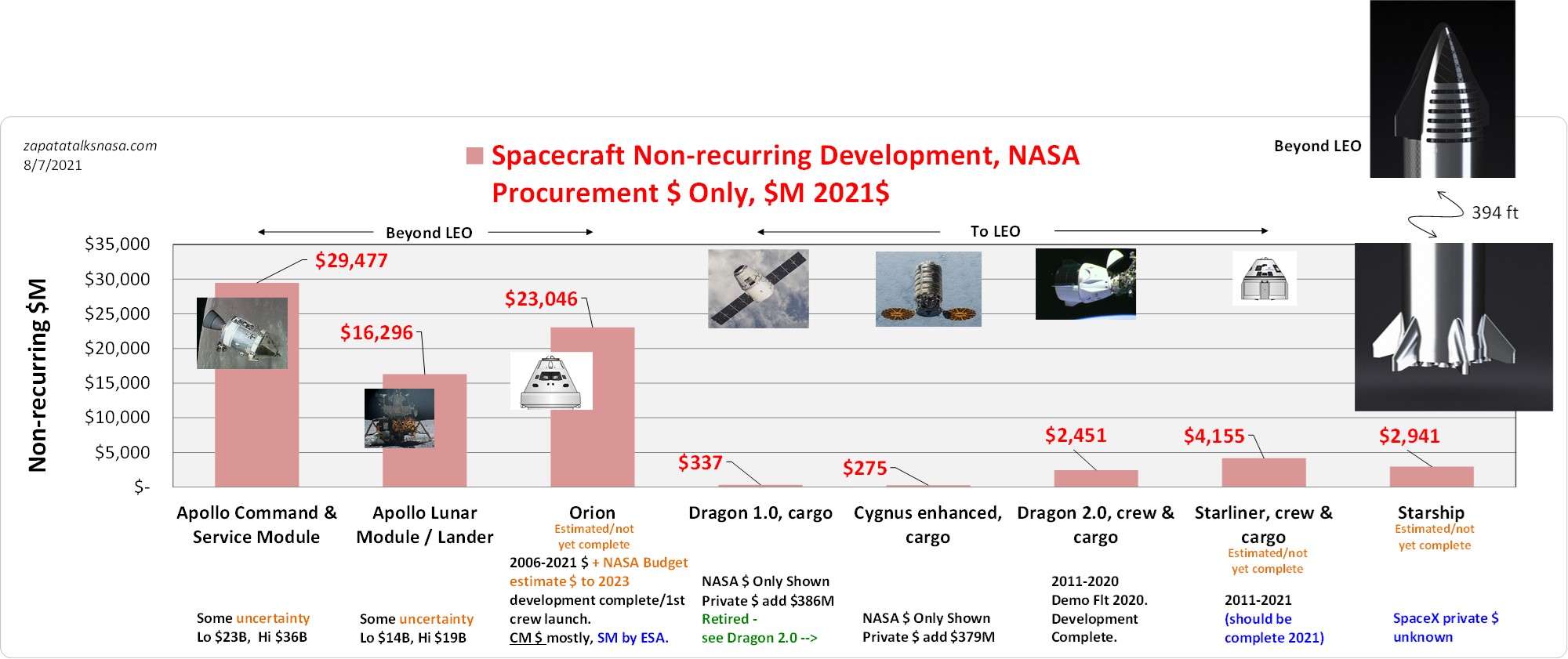
The up-front cost of US spacecraft for cargo and crew, “cost-plus” (Apollo, Orion), and as partnerships/commercial (the rest). Credit: Edgar Zapata, zapatatalksnasa.com
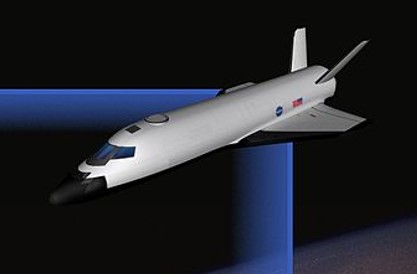
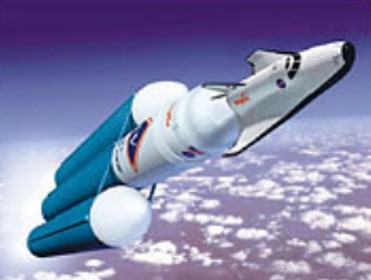
The Orbital Space Plane atop an expendable booster would have looked like a tiny Space Shuttle, wings and all. Yet amazingly, the smaller it got, the more it cost. Some might say the reverse, that getting costly the reaction was to make it smaller. The sub-compact must cost less than the SUV. More so, once NASA still gave everyone in Washington sticker shock, and as the newest policy circles turned their radar toward NASA, the billions to build a tiny Shuttle got the attention NASA didn’t want. A little humor about the high cost of miniaturization would have been appropriate. Except no one was laughing.
Instead, there were the usual explanations, a favorite being a bit of Horton hears a Who, except where a function is a function, no matter how small. And all those functions cost the same regardless of scale. Why the new space plane didn’t follow that logic in reverse and go big for a little additional cost never got proper debate. The Orbital Space Plane kept shrinking as if on auto-pilot till it seemed to disappear like the Incredible Shrinking Man. And so, we started to look down the path of capsules. Months later came the loss of Columbia, and capsules would soon prove to be the new favorites. Capsules were shapes amenable to adding emergency escape systems (for the way up) and simpler thermal protection systems (for the way down).

Fast forward to the NASA/Boeing Starliner that will soon undergo its second un-crewed sea trial (the first had its mishaps). But the week before that, a Starship also marked a milestone. NASA is partnering with SpaceX on a Starship as a lunar lander, and now award protests by competing partners have been put to bed. So, we might say we now have a NASA/SpaceX Starship that will be a lunar lander, or a lunar lander larger than the Apollo Saturn V, and fully reusable, which is a ship worthy of the name.
We have plenty of “Star” named things nowadays, after all. There is the Starliner, the Starships, and Starlink. But, like an iWhatever, the proper starter word is there to set a mood, if not about where we are, at least about where we want to go. (Starfleet, anyone?)
Progress, though, is a tricky thing to measure. All plenty of now you see it, now you don’t. The debate over technology stagnation, as real or imagined, is as endless as perspectives on what’s impressive vs. pedestrian. What do we expect in our lifetimes? A couple of features in technology discussions are missing when an optimist presents a case for being impressed.
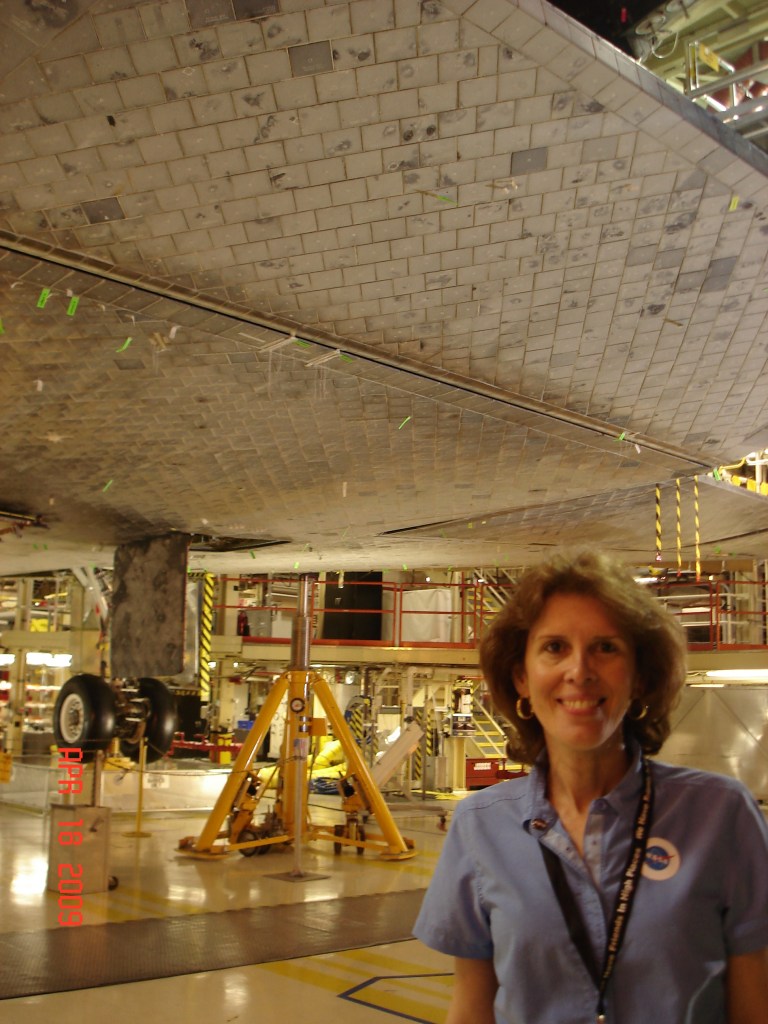
Progress. We should count ourselves lucky. It’s not every day you stand under a spaceship.
For one, it’s the graphs. Find any work showing that technological advances have slowed down, and you can skip the reading and jump right to the charts. Measuring things that matter in the routine of people’s daily lives – who would have thought. How fast are we moving, how long are we living, how different are our day-to-day lives? Is the robot finally for sale that walks the dog and folds the clothes or plots our demise? That would be progress.
Alternately, on the side of a slow march of progress, just hard to see, there are few if any graphs, but lots of inspiring stories. Two books by way of example – the pessimism in “Overshoot” comes from numbers and figures, while the optimism in “Abundance” comes from stories about people. “Look at this data,” battles “I’m so excited.” Where is the truth about the advance of technology, in data or anecdotes?
In between, we see where the future is always just around the corner, coming soon to a theater near you. The best example of this being Kurzweil, by sheer force of graphs wanting to show if we are not there yet, we soon will be.
Technology stagnation has graphs. Progress has stories.
There is another item behind more measures and graphs supporting the argument we are in a period of technology stagnation. As engineers and scientists, we tend to avoid economics even as much as it touches so dearly on the business of space. If progress is about remarkable changes defining how we look back on our lifetimes, then innovation is necessary, meaning competition. Yet, as economists point out, too many industries have all at once sorted themselves down to only one or two major players. This factor alone, the growth of vast monopolies, implies a period of technology stagnation. Where there is smoke, there is probably fire.
Yet what of our world of spaceships and spaceports? First, let’s look at the numbers (above). It took billions of dollars to make a crew spacecraft of the capsule kind in the 1960s. It took about half as much to make a small lunar lander to match. Give or take, these numbers are telling (aside – the costs must also be set by which craft provided more push for the trip.) Today, Orion seems in the range of the older costs, as if there has been little progress. Although, arguably, Orion is a little bigger than the Apollo spaceship, there weren’t any opportunities to learn about building capsules and their modules after Apollo anyway.
On the other hand, cargo as far as low Earth orbit seems to have figured out cylinders and capsules, automated docking, and such, even reusable ones like Dragon. All for bargain-basement prices. Oddly, it would seem that adding crew to low Earth orbit adds a zero to the up-front costs of a cargo capsule/spaceship, with the few hundred million becoming the few billion. Perhaps this is not the result of adding life support to a cargo capsule so much as reducing risk (and adding Federal Acquisition Regulations, even if firm fixed price). Then, there is the NASA/Boeing Starliner, which follows on the heels of the NASA/SpaceX Dragon, which has already taken US crew to the space station three times.
Which brings us to the other Star of the show. Having placed the Apollo lunar lander on the graph, we might as well place the lander selected for the Artemis program, the SpaceX Starship. If we can measure the lack of progress in numbers and graphs, what do we see here?
Offhand, this seems like a game where we are asked – “one of these does not belong.” Time will tell if Starships for a few billion to NASA are real or imagined. The graph will change, perhaps new data points here and there to give us a hint of what’s to come. In the meantime, I heard they put twenty-nine engines on the Starship booster the other day. And they rolled to the launch pad the next. Inspiring!


 Zapata Talks NASA
One thought on “Not in our stars”