“The gift shop is down that way, toward the lobby, past the spacesuit.” These are not the directions anyone can give a visitor lost among a run of offices and cubicles. You get away with this in the Kennedy Space Center Neil Armstrong Operations and Checkout building, home today to the Orion spacecraft, home once upon a time to Apollo hardware – including spacesuits. If we want to go to the Moon again and go out for a walk, however we get there, we will need spacesuits. That there is one in the lobby of our building under bright halogen lights, behind glass, would seem to say that new spacesuits are just a matter of looking up the sewing pattern and selecting a size.
If only it were that simple. Better yet, imagine a dramatic moment – the urgency, the mission, the last-minute secondary character asking, “Where are the space suits?’ The blank faces as everyone realizes there are none. Followed by the rush to unseal the glass case with the spacesuit in the lobby. The quick cut to the sound of sewing machines and people reverse engineering a helmet and the zillion parts of a portable life support system. A good director would keep these 42 seconds in the movie to lighten things up a notch.
A good director would keep these 42 seconds in the movie to lighten things up a notch.

This is not that movie. Reality is more like the joke by industrialist J. Paul Getty. If you owe the bank 100 dollars, you have a problem. If you owe the bank 100 million dollars, then the bank has a problem. It is now public knowledge that NASA Spacesuits might cost a billion dollars when all is said and done. Billion with a B. Yet this comes after a request for industry ideas with NASA considering partnerships for spacesuits as a service – much like other partnerships, paying for the ride but not owning the car. Does the bank have a problem, or does the US aerospace industry have an opportunity?

We might want a spacesuit to go to the supermarket during these peculiar times. We would look at the reviews on our favorite shopping site, avoiding the spacesuit with leaks. Water in the helmet obstructing your beautiful view of the Earth, not acceptable. Not to mention life-threatening. Size is also an issue, and since sometimes the returns are not free, we would pay special attention to having a suit with just the right fit, especially if you run small. Needing a spacesuit and not having your size in stock is also unacceptable.
In this real yet peculiar world, with an urgent need for spacesuits of the kind for walking on the Moon (not the zero-gravity space station kind, which is different), which glass needs breaking? And does the “in case of emergency” hammer cost a billion dollars? The answer for the curious is likely not the dramatic movie moment or as viscerally satisfying.
I see your numbers. I just don’t understand them.
Instead, the movie scene is based on true events, with names left out to protect the guilty, and begins with a phone call. The topic is a costly project, also unnamed. For all intents, the project could also be spacesuits. Caller #1 knows the project well and is a well-respected analyst who works closely with the project’s engineers. This person has boots on the ground. Caller #2 is purposefully at an arm’s length from the project, independent. For a review team checking if things add up, being at arm’s length is an advantage. For our characters, think “someone who did the taxes” and “someone who sees if the numbers smell right.”
“I see your numbers. I just don’t understand them,” caller #1 starts, with a voice that says they have had a long day, and we are skipping the usual chit-chat and catching up and how are the kids. Today, we go straight to the point.
“Well, that number is the grand total. It’s the sum from all the sources in the notes,” says caller #2, the independent reviewer. He is going for that help-line kind of voice. Sensing something is askew with his caller, he proceeds with caution.
“That’s impossible. You just don’t understand.” Yes, the tone has definitely shifted. This is not about figuring out something together, so more meetings and checking calendars. Is it leaning to let’s get it over with?
The independent analyst, always wondering if the last edits among the never-ending edits propagated an error through every spreadsheet in the galaxy (they are all connected after all), jumps to safety with a question. “Are our definitions different?” The number looks good, he thinks, after all – at most, an error in that last edit might throw off a decimal.
“No, it’s just not costs, you see.” The call shifts again; will this be a short call?
Analysts have patience in abundance for everyone except other analysts. The reviewer pauses – there is a possibility, a trace of what the problem is. But this topic has not come up in years. Could it be that infamous notion rearing its head again?
“I think perhaps we are talking about different costs, the spacesuit itself versus everything else?” says the independent reviewer.
“Well, everything else is not really part of the cost.” Bingo. We have found the cause of our failure to communicate. The “really” is pronounced stretching the “ee,” where I (you figured out who the independent analyst was, right?) could almost see my caller make air quotes with their hands.
This brings us to everything else. Adding up budgets, wholly spent with rare exceptions, should be what something “costs” NASA. This simple view is not so simple in everyone’s eyes. Sometimes, the budget says one thing, and the funds are spent on something creatively close enough. Research and development, ill-defined as it often is, is a poster child for this. Alternately, Congress provides specific funds for specific projects, and everything related to that project is paid from those funds (and sometimes even more taken from elsewhere).
The failure to communicate on this call was not the first problem. It was mainly the second. Consider the NASA Space Launch System, the Orion spacecraft, and the Kennedy Space Center ground operations projects. After that, a curious mind might subtract the awards to the Lockheeds and Boeings and make a pie chart because why not. Then, there is a little more math, as other numbers are known, like ground operations. Surprisingly, but not to analysts, there is still a sizable remainder.
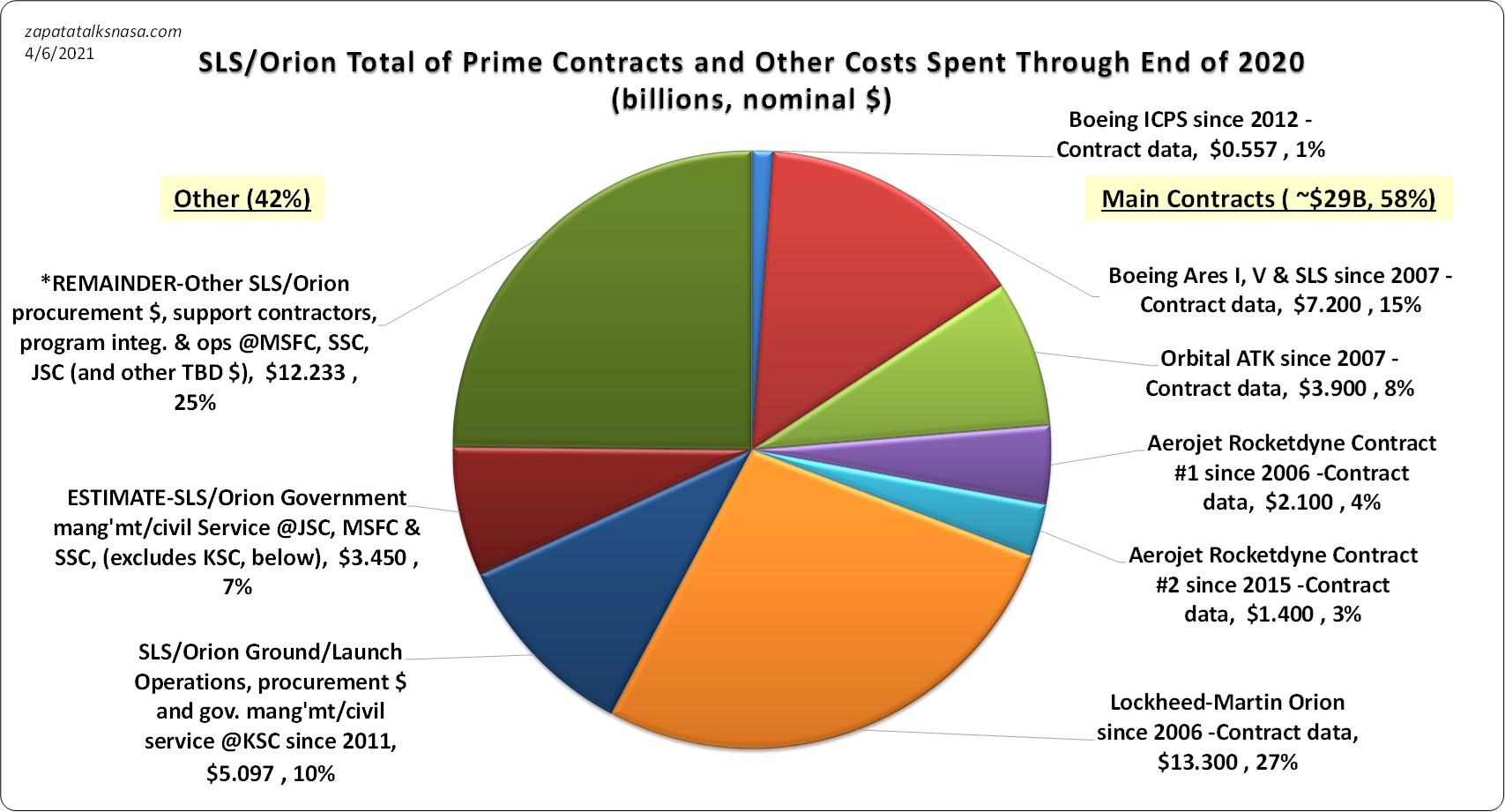
Of course, the totals will be high – they come from adding up huge budgets year after year. That is unless you believe – that is not what that reeealy costs. Why not even just the big awards are what that project reeealy costs. All of this is about the infamous notion – first seen in the wild in the mid-1990s, whereby the Space Shuttle really cost very little because if it did not exist, NASA would still pay to hold on to and keep everything else. (My Department of Defense brethren said the way NASA accounted for dollars was ripe for making projects an easy target of criticism. They gave themselves credit for having figured out how to turn large numbers into endless smaller numbers. Divide and you won’t be conquered.)

I have come to call this the “VAB Effect.” Albeit, this is really about people and organizations and not just buildings. If you only have one customer, inevitably, everything else, buildings and people, really adds up fast and really is part of the cost. (This is the part where I could cause eye-balls to roll upwards past what would seem physically possible. It would be a talk about indirect costs vs. overhead, institutional vs. corporate, knowledge vs. capability, support vs. prime, federal employee vs. contractor, and enough inside baseball to create new research avenues to help people with trouble falling asleep.) Imagine a restaurant keeping a large kitchen staff on salary, minus a menu, a specific meal request, or a customer. For years. Then saying, “You see, the food here hardly costs anything!”
The real question is about doing what might cost a billion, with innovation and new thinking, for much less.
As that call ended, we agreed to disagree. The most important question will not be if a number is a billion here or there, or twenty-three, or more when adding it all under one lunar moment. It is not even a question of bookkeeping or just keeping some standing capability needed for space exploration – the burner on warm, but not cooking.
Inevitably, history decides on the answer. The real costs are come to by adding up all the budgets as costs, as happened with Apollo. This is the simple logic of grouping results vs. dollars. (The independent analyst nailed it.)
The real question is about doing what might cost a billion, with innovation and new thinking, for much less. Requesting ideas is one thing. Taking up an offer is quite another. Which glass case needs breaking into? With urgency. The question that will follow 2.8 minutes later will be what to do with the VAB, and everything else?


Also see:
- 2001 Astronaut Bio-Suit for Exploration Class Missions: NIAC Phase I Report, 2001
- “The main objective of the effort was to research and design a revolutionary concept for human exploration missions, namely, the Bio-Suit System, which is envisioned as a locomotion enhancing, life support system for astronaut extravehicular activity (EVA) based on the concept of providing a ‘second skin’ capability for astronaut performance.”
- 2012 Building the Future Spacesuit
- 2013 Dava Newman: Space Fashion
- April 14, 2021 Artemis Moonwalkers, Space Station to Use NASA-Industry EVA Services | NASA
- July 27, 2021 NASA Empowers Industry in Spacesuit Plan for Artemis, Space Station | NASA
- August 10, 2021 NASA’ Development of Next Generation Spacesuits, Inspector General Report
- “Moreover, by the time two flight-ready xEMUs are available, NASA will have spent over a billion dollars on the development and assembly of its next-generation spacesuits.”

 Zapata Talks NASA
One thought on “The call, spacesuits, and everything else”