We knew the valley of death was up ahead, as we had been there many times before. Most wouldn’t make it. Well, to be truthful, we knew nearly none would make it. Wild ideas, new technology, and all those exciting, innovative projects that got anywhere from a bit of seed funding to serious dollars would all have to pass through.
In NASA-speak, technology has readiness levels. The levels go from one to nine. One is the kernel of an idea, a basic principle, while nine is flight-proven. New projects needing technology want to improve yet steer away from anything new, anything not at least at level seven, which has already been demonstrated and is close to the real thing. However, a teammate recently observed that some projects crave technology at level twelve, obsolete.
However, a teammate recently observed that some projects crave technology at level twelve, obsolete.

The valley of death came around level four when the gadget had to leave the lab. A tad over-dramatic, maybe. Yet the analogy truthfully captured the difficulty projects faced leaving the nest and fending for themselves in the real world. It was a desert out there, the heat, the vultures, and no water. For a dose of perspective, or at least sympathy, if you had spent 10 years of your career on a technology and then the plan to put it on the Shuttle went up in smoke, it was easy to feel you had wandered into the valley of death. And you knew you were unlikely to reach the next watering hole. Not to say the funding always went away, or your job. For most, it meant merely going back to the lab. Still, more years could go by, trying repeatedly to get that next big step approved. You might even get to the billion-dollar stage, around level six, only then to join the skeletons in the sand. Now, fifteen or twenty years had flown by.
This last month, NASA wrapped up testing on the James Webb Space Telescope (JWST). To provide some perspective about time flying by, I retired from NASA after 32 years, having begun my career there in 1988. If you began your career with the earliest studies about what comes after the Hubble space telescope, you arrived only a few years after me. You could spend your entire professional career on the James Webb project.
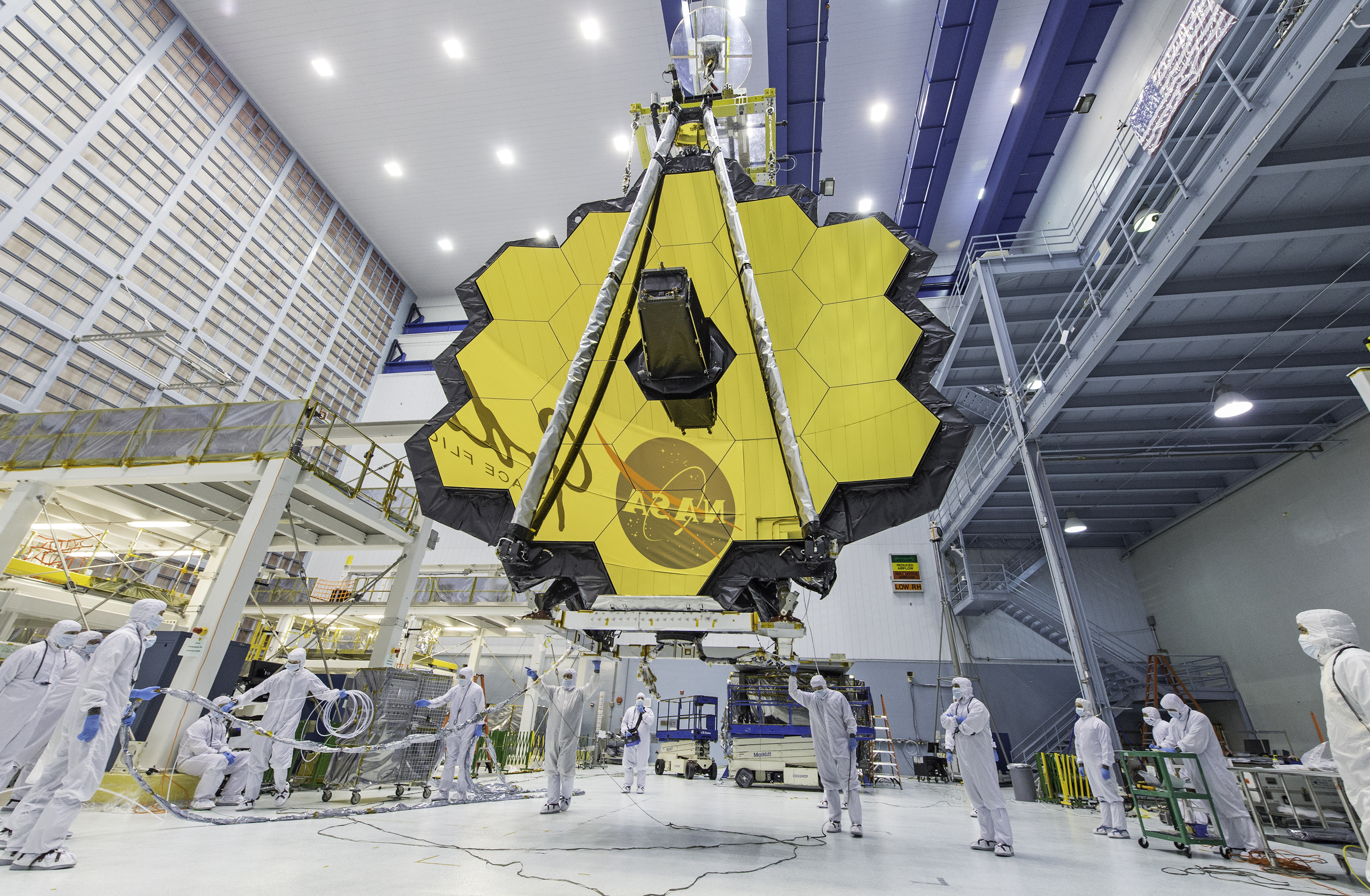
In dollars, the $10 billion (so far) on the James Webb is about half of what NASA has spent (so far) on the Space Launch System. It is also about half of what NASA has spent (so far) on the Orion crew spacecraft. This does not include the European and Canadian contributions to the telescope. More so, the $10 billion might be thought relatively reasonable. As the saying goes in NASA project circles, a billion here, a billion there, and before you know it, you have real money. Yet this is not about a dollar amount so much as a trend.
Fewer survivors are going through the valley of death each time. Each gets much more expensive, but budgets don’t get much more dollars. Inevitably, fewer survivors have the funds to pass level seven, regardless of merit.
These all seemed really clever observations at the time. Increasingly expensive technology, fixed budgets, and here we all go – into the valley of death. Denying anything was amiss, the conversation also veered into how the valley was part of life, natural in a research organization. A healthy research organization must have many more misses versus hits. But that, too, denies the trend, the fewer hits every year. Removing the NASA-speak, this is another way of arriving at an economist’s notions of diminishing returns and low-hanging fruit. In the private sector, it’s about arriving at the proverbial question – does it scale?
Or, as many professionals note, it costs much more every day for the newly minted medical doctor to put up a shingle even as lifespans stagnate.
If a satellite could see the impassable features from travelers’ tales to the valley, it might see technological stagnation. Recently, you can see the notion in physics, the lack of progress, as the 40 billion dollar collider is probably not forthcoming. Having picked the low-hanging fruit, we can’t just say “Next time, go bigger.” In the past, you might go bigger and explore more places, but now it’s about limits and fewer places. That’s not to say there is a consensus on technology stagnation as a phenomenon. Critics of the notion of technology stagnation have a conversation like Calvin and Hobbes, where we are “not sure people have the brains to manage the technology they’ve got.” By this view, we already have god-like technology (if paleolithic brains). Yet the case is often made that technology advances more slowly of late regarding real impacts on real lives. Or, as many professionals note, it costs much more every day for the newly minted medical doctor to put up a shingle even as lifespans stagnate.
As I often saw in complex projects at NASA, the answer may be in-between these views. And sideways. It’s not stagnation, but definitely not God-like either. This brings us back to the James Webb. A telescope gathering light is not like flowing electrons in transistors. Moore’s law does not apply. Twice a telescope diameter gets you four times as much light and more complexity. The James Webb will deploy sun shields, a central tower, a secondary mirror, and a primary mirror, among other housekeeping (deploying antennas, radiators, and more). All this will occur at a location beyond the Moon.
The telescope after James Webb can follow a straight line, just going bigger. Simply put, more area means more light. Imagine how soon we get to that next telescope, and for what cost? Expectations are tricky, and technology expectations are the trickiest.
I have the privilege of supporting the NASA Innovative Advanced Concepts (NIAC) program as external council. The recent portfolio includes exciting ideas for how our next-generation telescopes might come about. A low-frequency radio telescope on the Moon? Build it from what’s there. (“FarView – An In Situ Manufactured Lunar Far Side Radio Observatory”). Another idea is to deploy a reflector one kilometer in diameter inside a lunar crater, packaged as a mesh. (“Lunar Crater Radio Telescope (LCRT) on the Far-Side of the Moon”). Looking for small asteroids, the most plentiful and valuable for resources, and the easiest to get to? Combine new information processing capabilities with multiple small telescopes. (“Sutter Ultra: Breakthrough Space Telescope for Prospecting Asteroids”).
These were days when even trying to figure out bending time and space was on the table.
It was decades ago, a conference on hypersonics. An entire day was dedicated to wild ideas, and there was no lack of these. There were plasma deflectors to reduce shock waves on spaceplanes, laser craft, so huge ground lasers, and super-conducting innards in engines. Somehow, the program manager even finagled some funding for fusion energy (by asking if it fit into an engine). These were days when even trying to figure out bending time and space was on the table.
Today, there is similarly no lack of wild ideas. The kids really are, alright. Also, there is no lack of experts and speakers and motivational optimists ready to repeat a mantra about innovation. (If anything, these are more abundant than ever.) Connect the decades though, and perhaps a lack of innovation is not the root problem. Recognizing the trend set by programs that simply go bigger, as Augustine noted, the single airplane eventually shared by the Air Force and the Navy seems too possible.
More innovations need to make it past the valley of death, not fewer every year. Inversely, that means fewer eggs in the same basket, so there are actually funds available. Figuring out how to do this may be the best innovation of them all.

 Zapata Talks NASA
3 thoughts on “The valley of death”