Recently, NASA lost contact with the Voyager probe, a mistaken command signaling its antenna to turn away from Earth, and what tiny tickle of a communication connection remains. This was cause for concern, naturally, though in the grand scheme of things, after a long and productive career, Voyager already did everything it set out to do. What more could we ask for? Perhaps the brief collective sigh came from remembering Voyager is one of a handful of times when Earth put a blog out there that someone may or may not read one day and may or may not understand even then. I can relate. Voyager’s Golden Record, filled with everything from the songs of birds and whales to Louis Armstrong and Ann Druyan’s brainwaves, was everyone on Earth sharing. Perhaps it will read like a rant, or a stream of consciousness, as sentimental or too obscure. Nonetheless, we put ourselves out there for the galactic record.

In NASA, it was common to hear someone say – “V’ger” – recalling the fictional Voyager that came back home scarred, smarter, and self-aware in Star Trek, The Motion Picture. V’ger was fiction, but it was also acutely close to home, not much different from the sense about the real Voyager and us – growing, learning, and exploring, and asking questions like why and what’s it all for?
Thankfully, there is a chance to keep learning about our neighborhood, as NASA reestablished comms – for a while longer.
And yet, Voyager’s long-term mission depends on neither continuing communication with us nor the life of a power supply. It must only carry that Golden Record adrift in space. For sure, the odds some alien scientists will happen upon this message in a bottle, an artifact the discovery of which may change their history if not ours, are truly abysmal. Less than zero would be the first back of the napkin calculation. With a long list of complicated caveats, there are only about four truly Earth-like planets within 33 light years of us. That’s Earth-like, not merely Earth-adjacent, simply rocky vs. gaseous, or just in the right spot vs. too hot or cold, or almost akin, but really too large to give up light gases or too small to hold on to an atmosphere. Four. Give or take. And we would have to be heading the right way if we knew the way that is.
With a long list of complicated caveats, there are only about four truly Earth-like planets within 33 light years of us.
Making matters worse, we can imagine a flashbulb effect. In the grander scheme, life flashes by for whole planets, not just us. We would have to launch our arrow toward the right place at the right time – when intelligent, technological life arises within those few tens of light years of us. If such life is short-lived, the flash of life here is over before the other flash fires nearby. Alternately, four is a vast number for the possibilities each represents. And in an eternity, time may have a tricky way of checking off every box – even the cases that are a billion to one or less.
Or this may all be beside the point.
-o-
Unfortunately, as the Space Shuttle flights ended, it was too common to hear critiques that confused value with scarcity. We have the odd habit of wanting something more the less it is available. The moon landings ensured the name Armstrong took up residence in everyone’s mental reservoir of historical firsts. But no one (outside the space centers and us employees) could name a Shuttle astronaut. Time to go to Mars and repeat the glory years – and get another name on everyone’s mind.
Having left the Shuttle program to work on projects advancing routine and affordable access to space (or wearing two hats for a while), this recurring theme where the inaccessible was more desirable haunted some informal discussions. The thought rarely reared its ugly head in public, but it was proudly paraded around the dinner table in private. Astronauts remain revered figures, off exploring where no one has gone before – well, where not many have gone before. Yet somehow, the slight opening up of space to women, a teacher, and scientists who were not test pilots, civilians, or someone 77 years old, was seen by some as straying from being memorable. Participation, 852 people flew on Space Shuttles, is easily confused with being ordinary. That is, until it’s not, as with the loss of Challenger and Columbia.
A very human Colonel Hardy and a scientist getting his hands dirty, albeit on a suicide mission, help save the day…
Pop culture reinforces the idea of mythos as unique – but with the extraordinary camouflaged as accessible, pretending anyone can participate. The superhero origin story begins with an average human, but the other unenhanced lowly humans rarely save the day. A very human Colonel Hardy and a scientist getting his hands dirty, albeit on a suicide mission, help save the day in Superman: Man of Steel. This is a rare exception. Superhero universes are not as inclusive as they seem. Even if the radioactive spider bites a high school student from Queens, those with great power are responsible for saving the day, not the humans fleeing the crumbling buildings. We rarely get to participate, apart from running, screaming, and being saved.

Routine, affordable access to space was our mantra for a time. We believed if we could get cargo to space cheaply, then people, everyone else, would follow. The Shuttle tried to increase access to space, and for all it lacked in affordability, it is to date the system that has put more humans in low earth orbit than any other. The International Space Station continues this push. The theme remains – everyone should be able to participate and benefit. This idea, too, comes from popular culture – this time, the sense we are all capable of dragging ideas from an imaginary universe into our real one.
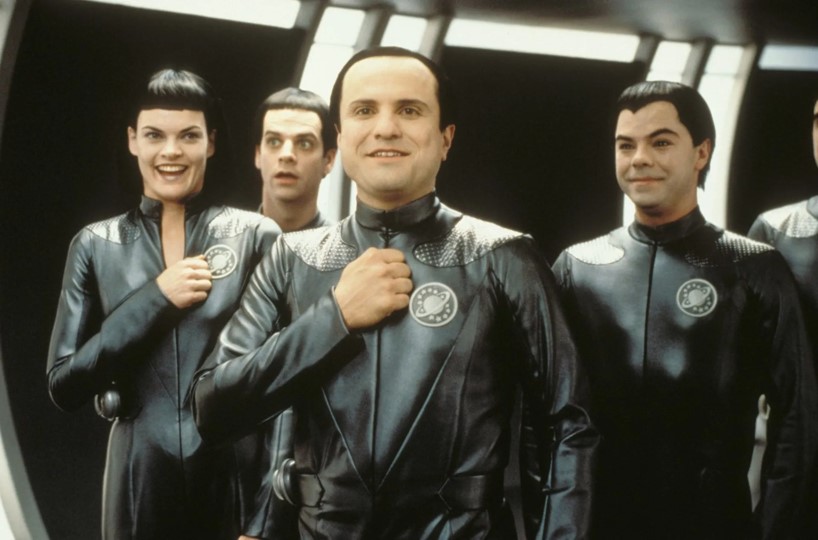
In Galaxy Quest, the story revolves around Thermians, aliens that see our televised sci-fi and believe they are “historical documents.” The Thermians describe a society fallen into disarray until they modeled themselves around the courage, teamwork, and friendships they saw in these “transmissions.” They recreate the technology and culture they become enamored of in their child-like innocence. They didn’t know it couldn’t be done, and so they went ahead and did it! Sound familiar? Engineers and scientists also try to recreate the historical documents that inspired us as children. Books, movies, series, parents, teachers, role models, real and imaginary – they are all there for us, filling our need to create our own unique frameworks for meaning. This was inevitable. The polytheistic world of trinities, gods, demons, and favored saints has surrounded us for millennia. It’s a small leap to similarly flavored new structures influencing how we model our lives, participating more with every jump.
-o-
Like the Golden Record, which makes excellent listening while trying to turn meandering thoughts into meaningful words, writing has been my drive to share. The Space Shuttle, or advanced projects, in NASA and the US Department of Defense, were a taste of turning “historical documents” into reality. In the space business, we are all Thermians. Who will receive Voyager’s historical documents? We will never know. I am sure these transmissions affect the sender, writer, or creators. And when everyone can play and benefit from space science and discovery, the historical documents will show us at our most extraordinary.

 Zapata Talks NASA