Throughout my career at NASA, I analyzed, prioritized, modeled, simulated, facilitated discussions and teams, wrote and reported, and got my hands dirty with, and crawled around lots of space technology. Eventually, I enlisted an AI-ish algorithm of sorts when it was clear some non-human help might do what a person or a team can’t in a lifetime. But today, all I have is a story, and getting hung up on the meaning of some words.
It is so early that there is not even the initial sense of getting started when my contact from the other NASA center strolls in. The conference is called off. Slide decks sat ready, as did the coffee machine next to the neatly laid-out snacks. I made arrangements for tours because if you are at the Kennedy Space Center, I must remind our visitors there is a reality to what we are about to debate and decide. Still, we got stood up. The manager, many tiers above my pay grade, arrived at the center but sent his underling to say, “There’s been some miscommunication.” Having asked for ideas on projects that could save money, he meant save money – this year. Or save money now, yesterday preferably, from the tone as the conversation went back and forth. I tried to understand what happened. Ideas about future savings were of no interest, especially as it became clear the manager’s initial financial liquidity had now evaporated.
This story dates to a few months before NASA’s previous Moon program was canceled, about fourteen years ago. I vacated the conference room alone, calling down the list of presenters or greeting the early risers like myself with the bad news. Research and development and projects that advertised spend now, save later, were under fire for years, so the sudden order to halt today’s festivities did not catch us off guard. We accepted that the artillery across the river would soon dial in on our coordinates. For a while now, the chatter was “Constellation program” and “unsustainable” in the same breath. The meeting’s abrupt cancelation confirmed the diagnosis. Though, at the time, affordable, sustainable, and other close cousins remained words taking different and shifting shapes.
Imagine a factory making paper. Call it Dunder Mifflin, and you can easily see people talking about the paperless work environment, perhaps in a panic. Along comes a twist as the company discovers the word “sustainable,” like the latest fashion it absolutely must buy. Some trees are planted, or at least it looks like that in the ad. Maybe it’s endless trees. A tree logo. Slides about the importance of paper, sales still amazingly strong, even after email and “save a tree” campaigns. Everyone agrees that the business is infinitely sustainable.
This view of sustainability confuses importance and demand with supply and the long-term prospects for that supply. A view of sustainability as the agreed-upon significance of the task or the number of sales orders is incorrect and backward. Here, up becomes down, and down becomes up.
“…it’s worth asking what has changed in NASA’s current Moon plans.”
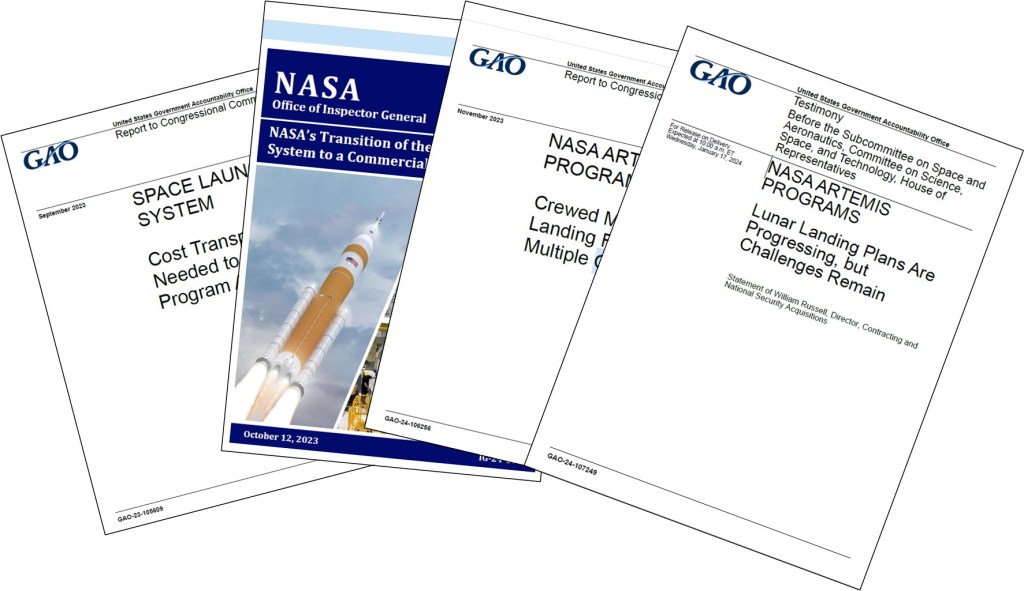
Now, years after that canceled conference to present ideas with future benefits and the schadenfreude soon after everything got canceled, it’s worth asking what has changed in NASA’s current Moon plans. In 2023, plenty of experts reviewed NASA’s Moon exploration plans. The chatter is still what it has been for a while: “Senior NASA officials told GAO that at current cost levels, the SLS program is unaffordable.” We also heard from the NASA Inspector General that the NASA SLS rocket has a price that is “unsustainable.” In the polite version, NASA’s current Moon plan has “challenges.” In these reports, so many, umm, challenges. (A thesaurus would have been helpful.)
A tempting first reaction is redefining words – starting with “sustainable” and “affordable.” These are a couple of classics in the hodgepodge of NASA-speak and the reports from the NASA Inspector General, the General Accountability Office, and the mattress mice (like me) who can’t resist chiming in. In a Decadal Survey, we find that view of sustainability akin to stating the importance of paper or the likelihood that sales orders keep coming. When sustainable means “widely accepted reasons to continue human lunar exploration that justify the continued investment, commitment, and risk,” we rightly see the importance of what NASA does and its goals. But we miss the mark, as missteps can still happen, even in important matters. We forget about the growth rate of the trees as if the paper plant exists in a vacuum. In this view, so long as demand persists, all is fine.
Another view on sustainability embraces our survival instinct. After the previous NASA Moon program was canceled, an amazing aspect is how the parts kept going, as if they never got the memo. Solid rocket boosters – check. Old Shuttle engines – check. The capsule for the crew – check. The giant rocket for it all – that, too, continued. Only an upper stage and its engine met their demise when the previous Moon program was forced into retreat. The empire, we found out, strikes back. And as for that upper-stage engine, it remained alive and kicking for many years after. There was persistence, continuity, staying power, and stability in the Shuttle hardware, infrastructure, and organizations.
I have roamed around the vestiges of the Apollo program that came before the Space Shuttle. In the 1990s, Kennedy Space Center still had the old massive Saturn V liquid oxygen pumps, purged with nitrogen 24/7/365, just in case. Years later, I explored the facility that now houses the Artemis program’s Orion spacecraft, also built for Apollo. My initial foray into the facility found drips and leaks, mold and mice, and wishing I had dressed down that day. For the visual, think post-apocalyptic Hollywood B-movie. As the boss used to say, keep all the stuff you can when a program ends. One day, it gets us in the door to say we are ready for the next program. Keep a straight face on the bullet point “use of existing facilities reduces cost.” Though frankly, it was about closing the door to anyone who said to do it right and from scratch or elsewhere. Once chosen for the next program, and after we upgrade the handle on the old hammer with a new one, and replace the head too, we would be ready to drill holes. With such proven persistence, it’s easy to assume whatever NASA does is sustainable – on some level.
The official NASA view on sustainability is close to what’s typical outside our little aerospace world. Sustainability is about actions today that do not compromise tomorrow, creating the conditions to persist. Yet “to execute NASA’s mission without compromising our planet’s resources so that future generations can meet their needs,” says more about a factory conscious of waste. There is a long view here, but about the process, not the product out the gate.
A clear view of sustainability and human spaceflight can appear elusive. Seeing what we have is a start, avoiding the word salads and circular phrasing, sustainable as continuing to not be canceled. A critical mission – check. Clean execution, as conscious stewards of Earth’s limited resources – check. Likely to continue to receive funding from Congress – check.
“…avoiding the word salads and circular phrasing, sustainable as continuing to not be canceled.”
After importance, execution, and stakeholder support, questions still linger. Too many questions. We stood ready that day long ago, prepared to work toward a result far ahead. No mission, product or success is sustainable without looking ahead. Today, NASA’s Artemis program at least exists in detente with NASA research and development (if an uneasy truce says the chatter.) No longer are there many voices saying every penny in NASA must divert to the objective of astronauts landing on the Moon. On another positive note, NASA went the way of commercial partnerships for its lunar landers and spacesuits – more than one for each. Not that NASA was given enough funds for any other path. Go commercial, and you can suddenly fund multiple landers for a few billion here and a few billion there where the previous plan couldn’t see past one lander for tens of billions. That Starship slash lunar lander can be more, but a lander will do for now.
A decent R&D portfolio -check. An R&D portfolio that is no longer seen as merely a reserve fund for a lunar program – check. Respect for the proposition some investments only pay off in the very long term – check. Some commercial partnerships for significant elements of the Moon plan – check. To answer the question, a lot has changed since the last NASA moon program. Add these elements to the value of the endeavor, being good stewards along the way, and stakeholder support (mostly.) NASA scientists and engineers are fond of musing – this is all necessary, but is it sufficient?
R&D and commercial partnerships remain junior partners in the total NASA human spaceflight picture. A “sustainable NASA (lunar) Artemis program” screeches on the ears, over-valuing the stability of the means, not the achievement of an end. Still, continued means is necessary. A sustained human presence on the Moon soothes the nerves, remembering results, but risking the space station view of a home for a select few. That our solar system presence begins with a handful of people is natural and necessary. But bringing about a *growing* human presence in our solar system will inevitably need all this – then more. More R&D investment will be necessary to turn the curve, where more ambition is achieved for less than we can imagine today as we drown in some budget shortfalls. More commercial partnerships will also be necessary, as already proven, to fit ever more capabilities, enabling growth, in budgets that continue to lose purchasing power. Growth will not occur by doing less every year there are less (real) dollars. As to more ideas with some payback in the future, necessary, but it won’t be about that either. It’s about saving a future with a growing human spacefaring presence before word arrives it’s been canceled.
-o-
And, to start 2024, we have the NASA Aerospace Safety Advisory Panel (ASAP) report.
If those talented and dedicated personnel are cognizant that they are embarked on a journey that is not just challenging and risky, but not realistically achievable, there will be both a serious erosion of morale and an undermining of the essential safety culture.”
Now another question – what would be the assortment of projects under the Artemis program that achieve results that are both “realistically achievable” and credibly connect to a growing human presence in our solar system? If it is not the current portfolio and funding mix, or if you can adjust to be realistic, but not to grow, let’s talk some more.

 Zapata Talks NASA