If NASA were your bank account, investments, or 401K, after seeing the headlines, would you check your balance more often or less? Our very human “negativity bias” says we might check more often, an overreaction to possible danger. It’s what got us here. You and me. We are the children of creatures that spooked more readily at the whisper of movement in the tall grass. Best to run now, think later. The companion with a proper sense of measure did not make it back to camp that evening to make copies of his more chill nature. We are told this ingrained leaning to perk up more at signs of danger than to celebrate success is a good thing, as if we should always listen to our programming that skips the part about thinking.
Though the mind being what it is, we discover there is the “ostrich effect.” Now, bad news is like the stress of that sound in the woods, and we react by avoiding it. We might even shoot the messenger. We check the balance on our 401K, less, or not at all, hearing about a market downturn. Or sell, sell, sell! Startled at any rustle of leaves, we go back to camp with no food for the day, again.
What’s a complex machine to do? If it all sounds maladaptive, like a brood of turtle hatchlings executing their lines of code and heading to the porch lights instead of the sea, it probably is.
Regardless, it’s time to check NASA’s bank balance.
We’ve come a long way from the savannah. (With many disclaimers.) Perhaps selling is what the moment calls for, if we thought it through. Time for a big short. Or maybe we hold, or even buy. We can think and override our program. After all, who’s in charge here?
Regardless, it’s time to check NASA’s bank balance. First, the balance yesterday.
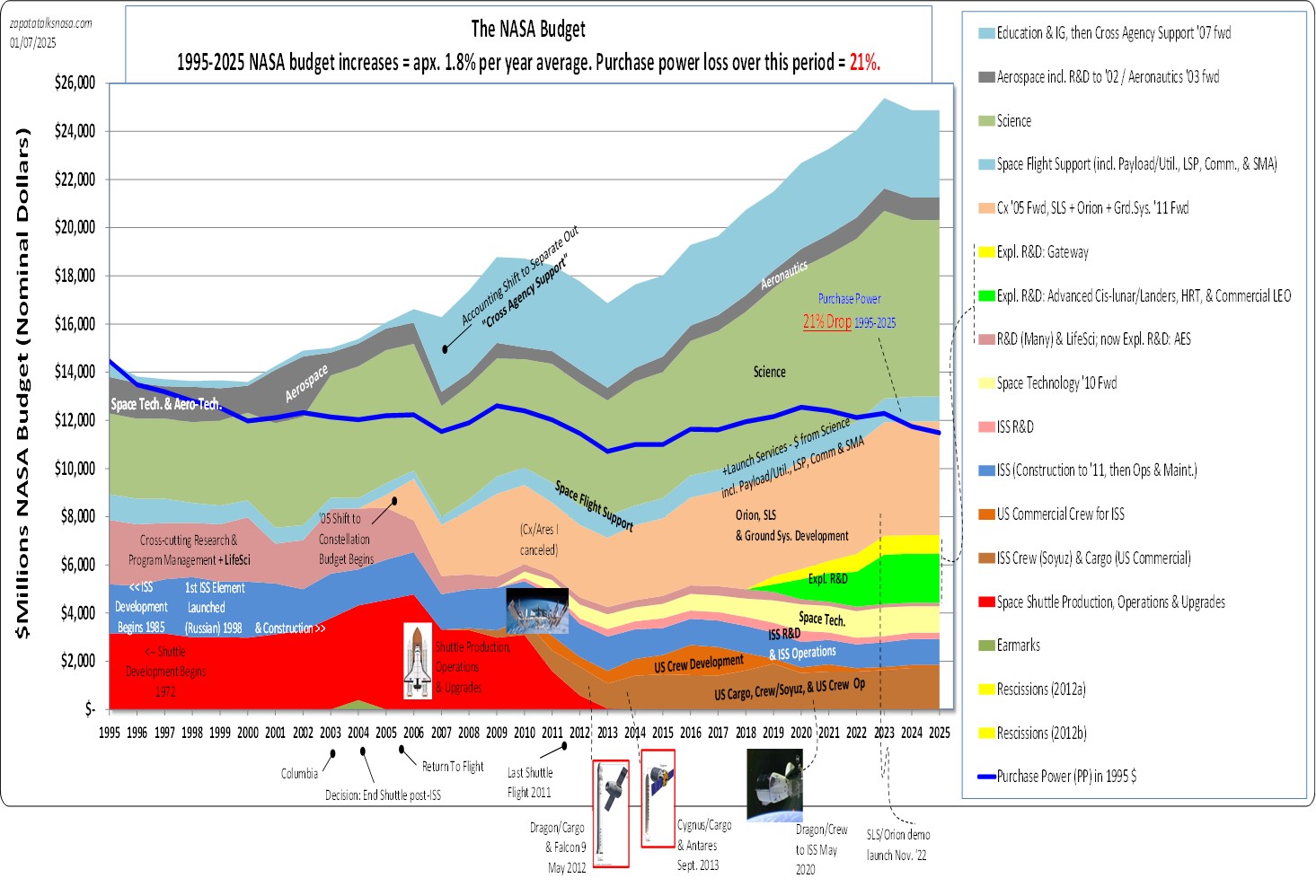
Looking back thirty years, NASA had already lost a fifth of its purchasing power. Think frogs, boiling, slowly. Very slowly. The recent advance in lowering launch costs to NASA, thanks to the NASA/SpaceX partnership that began with getting cargo to the International Space Station, helps, but only so much. These are the thin brown lines at the bottom of the graph, less than the red Space Shuttle line, and what NASA would otherwise have paid for transportation to and from low Earth orbit. Much less, in a sense, considering that even if the lines were level, the commercial crew and cargo systems available today would still represent fewer dollars, after inflation. (Imagine that the same steak at your favorite restaurant from ten years ago costs the same today.)
In some years, those flat ones in the 1990s, our joke was “flat is the new up!” NASA was then told to go faster, do better, and, oh, by the way, to do things more cheaply, too. Ahh, the nostalgia. But I digress.
Is a graphic warning necessary here? Do we prefer to avoid bad news?
Is a graphic warning necessary here? Do we prefer to avoid bad news? To be on the safe side: “The following program contains material that may be disturbing to some viewers.”
This is the NASA budget as it may be in 2026. By all indications, “may be” is happening now.
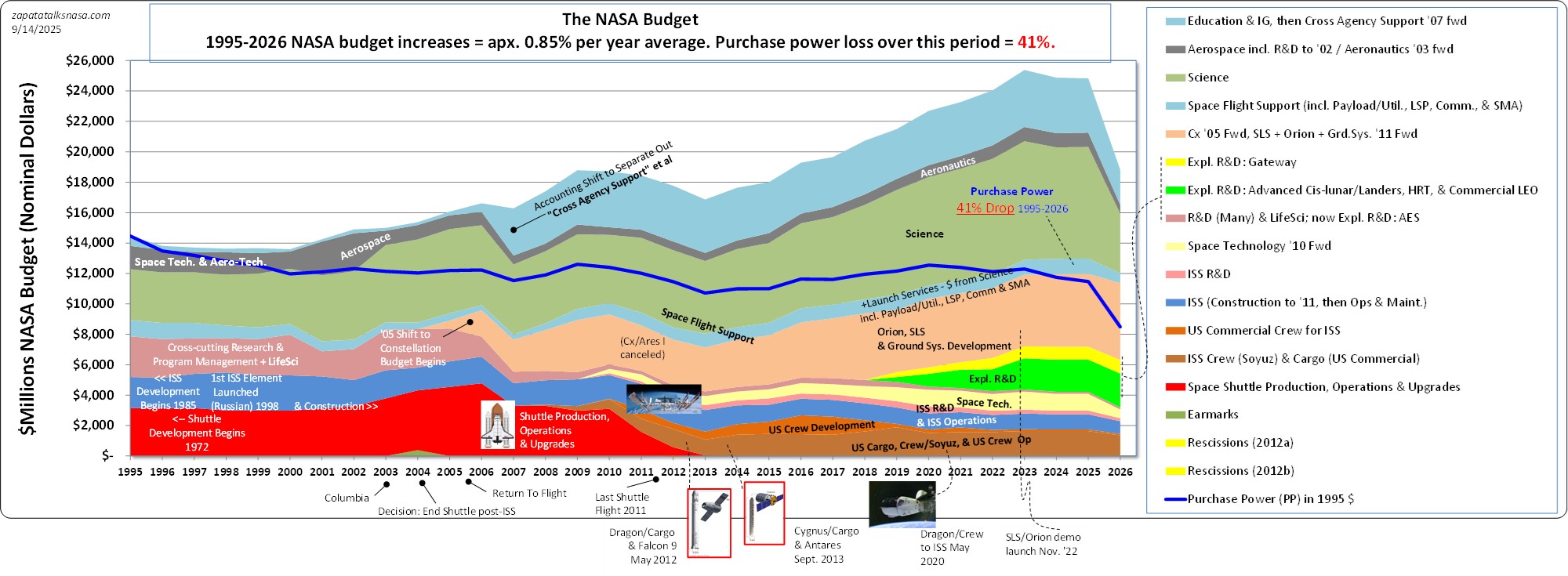
Human spaceflight does not fare badly in 2026, at first glance, as the puts and takes for the lower half of the graph somewhat cancel out. The 2026 White House budget proposal to end the Space Launch System and Orion lies far in the future, a few launches ahead. (Which in SLS and Orion years could be a very long time, like where a year for you is seven for your dog. /s Sorry, I could not resist.) There is another wildcard here, a line item thrown in to recent appropriations that adds funds for the International Space Station, to keep the Gateway, and to keep the Space Launch System and Orion around for more launches. The lord giveth and taketh and giveth, and time will tell how those dollars land in NASA’s 2026 Operating Plan. (These are usually not revealed until the year after.) Human Spaceflight is about to circle a gigantic piñata. Think blindfolds and sticks, all at the same time.
The real hit for NASA, and soon, is seen in the upper part of the graph, NASA Science. Once, Starfleet prospered, exploring strange new worlds and understanding our home planet more every day. Now, so many ships will soon be lost.
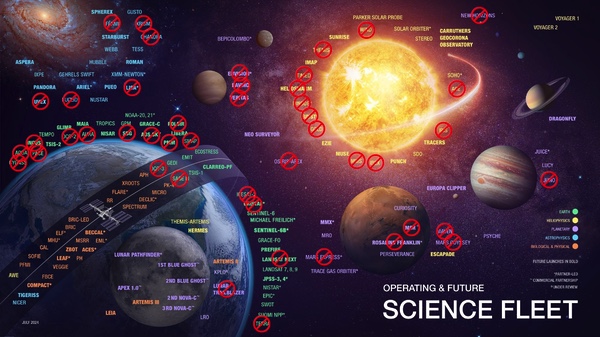
The self-destruct codes being entered will especially affect NASA Earth and Life Science. Spacecraft taking the pulse of Earth have delivered invaluable data about our climate, a warming planet and the role of human produced carbon-dioxide in a changing climate. If there is an account balance worth checking frequently, this is it. Earth’s mutual fund. How’s it going? Our negativity bias says we should perk up, to the data. Also to the shutdown of our ability to keep tabs on the account. Or we could react maladaptively to the stress, seeing nothing but messengers bearing bad news. Check the account less often, or not at all.
Or it’s time for that question again, about our programming and tendencies, weather to doom scroll or to shoot the messenger. All of which forgets to ask, who’s in charge here?

 Zapata Talks NASA