Who would have thought rockets and an internet in the sky, and not “cost-plus” either, would create the wealthiest person in the world? Ridiculous? Of course not. Or a private sector astronaut as NASA administrator.
When I began this blog in 2021, my drive to put words down and toss them out there for the world started with a sense that we had long been in an era of technological stagnation. If you worked on enough NASA projects pushing what could be the next big thing for decades, mostly in space transportation, it’s easy to see the connection. More often than not, these tasks felt like pushing a wet noodle, with everyone insisting that it was better than pulling. All with meetings and debates about technology push versus pull, replacing new technology adoption by whatever means, no matter how it arrived on the doorstep. Not that much new technology showed up ready to be adopted.
The evidence for this bleak view is 322 feet high. No, not the paperwork, that would be wider and higher by many miles, not counting the lines of code, if printed. The reusable launch vehicle work of the 1990s into the aughts, a natural step forward from a first-generation semi-reusable vehicle like the Space Shuttle, has today spewed forth the NASA Space Launch System (SLS) rocket and the Orion crew spacecraft. Here’s tweets as technology, only more toxic.
NASA kept, as holdovers from the Shuttle days, the solid rocket boosters that blew a gasket, resulting in the loss of the Shuttle Challenger. Not to make poor decisions once and be done, NASA (admittedly, on orders from Congress) also kept the bright orange tank that shed chunks of foam, catastrophically damaging the Shuttle Columbia (unbeknownst to the crew until reentry).
Of course, the elephant is sitting next to the gorilla in the room. The SpaceX Falcon 9 has changed access to space. Innovation that it is, it took advantage of the minimal payload loss when a first stage returns to Earth vs. a second or orbital stage (as with the Shuttle). There are landing legs, extra propellant, and additional structure and complexity, which means the first stage’s mass displaces some of the payload capacity. But the amount lost is acceptable, leaving ample payload.
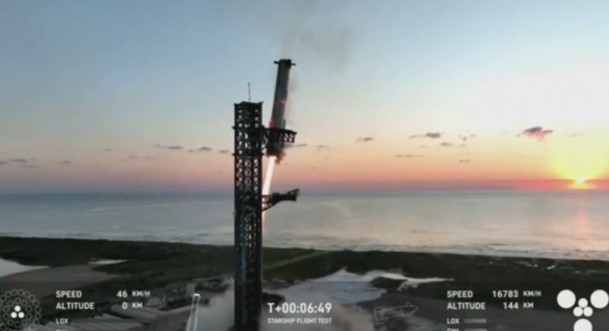
Trying the same trick to get the stage back that enters orbit is likely to result in zero payload capability. Which leads to the massive stainless-steel Starship. No landing legs now, best to toss those and catch the returning vehicles with Mechazilla arms. Crazy kids. But no way to avoid thermal protection systems either, for the stage coming back from orbit, you need tiles, of the sort not far removed from what covered the Shuttles. Better tiles thanks to NASA research.
Are we on track to get 140 characters and flying cars?
Technology has made the world’s wealthiest person, Elon Musk, with an estimated net worth of nearly half a trillion dollars as of this moment. It would have been easily predicted in 1997 that the world’s wealthiest person made his wealth in part from a rocket company. This, as we discussed some old science fiction over dinner after the conference. After a few. More than a few. With a segue right into Star Trek episode plot holes. Add in an electric car company that is single-handedly holding up what electric stack future there is in US manufacturing? That’s just gravy. The old joke, “How do you become a millionaire in the rocket business? Start as a billionaire,” is even funnier now.
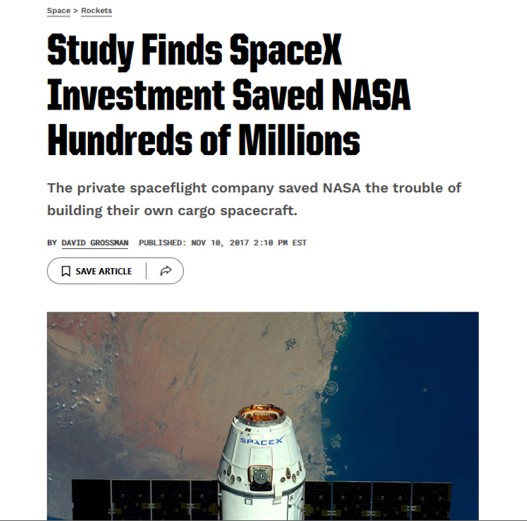
But all this did not happen in a vacuum (pun intended). NASA took a risk by investing in companies under new results-oriented contracting methods, leading to the SpaceX Falcon 9. Much of the current ado about everything “space,” “SpaceX,” and NASA follows from that success. Not that more NASA commercial investment in the same direction came without lots of yelling and screaming. When I published an analysis in 2017 of how successful the ISS cargo investment was, reducing dollars to NASA by trip, per-pound of cargo, and up-front development costs, the jury was still out. The internal NASA response was that the analysis must be flawed. It’s too confusing anyway. Mostly, that the commercial cargo program to the ISS should not be taken as meaning much for future directions. I came to understand rocket scientists can only calculate delta-v and fuel levels to the ounce and orbital mechanics over a light-day, but don’t ask them to add up dollars. You get, “I’m an engineer, not an accountant!” And marrying technology to budgets, or decisions to dollars, was even less welcome.
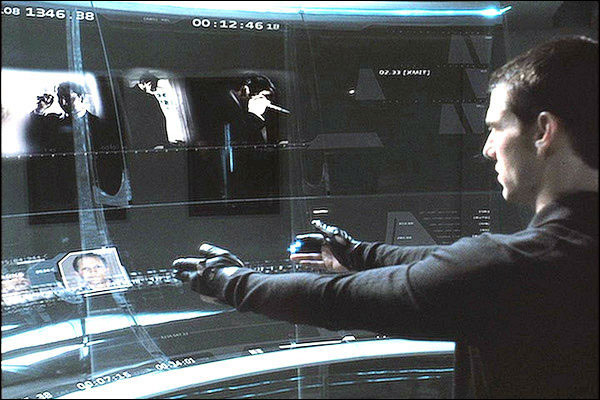
It is all challenging to connect, but not in the way expected. Technology development naturally goes through phases of low-hanging fruit. We grab what’s easy to grab first, then the rest lies further up, feeling more difficult to reach because it is. Stagnation ensues. In 1994, I showed up at Kennedy with the first laptop many people had ever seen firsthand. I tossed these computers aside every two years and got another that seemed so much more advanced, but by 2005, I would be unable to buy a computer any faster or more capable than the previous one. I was holding out for something more “Minority Report,” including the gloves, to really get cranking on those calculations. That or brain implants. I’m still waiting.
Tyler Cowen explores this phenomenon, reflecting on the causes of stagnant economic growth in advanced economies, including the United States. Yet we also see a rising stock market held up by whatever is the latest machination – now AI, from chips to Chat.
The easy out is to say that the one, this beast we call the economy, GDP, and productivity factors, and the other, the markets, are two sides of a coin. One is now, and operational, the other is all tomorrow, all about promise. A productivity measure of what exists is not a valuation about what may be.
This sounds familiar, too, but unsatisfying.
Today, Jared Isaacman had a second nomination hearing to be NASA Administrator. NASA may again have an astronaut for administrator, with a twist. Isaacman has gone to space twice, but on private spaceflights. Flights of this kind are made possible because the price of a Falcon 9 rocket and a Dragon spacecraft is within the reach of a mere billionaire.
Lightning must strike twice, with NASA’s investments leading to an orbital facility (or many) that look back on the ISS as today’s SpaceX rockets and Starlink might look back on the Space Shuttle.
Isaacman arrives at NASA in the middle of a car crash, ejecting research and technology through the doors and windows. Closed windows. And closed doors. This is the same research and technology that got NASA and a growing, promising commercial space industry merrily down the road to where they are today. There is no more Concorde for sure, or the Space Shuttle, or dreams of maglev trains or hypersonic space planes, but there is a possibility. There is promise.
Falcon 9s may give way to massively more productive Starships. Not that Falcons, having placed thousands of Starlink satellites in Earth orbit, don’t also have bragging rights on that count. That Starship is funded by NASA as much as SpaceX, as its first task is to be outfitted as a lunar lander.
Research aboard the International Space Station should be seen as the same kind of investment that connects NASA and rockets to SpaceX and Starship. Knowledge is gained at great expense, then spreads like a diaspora, but eventually a compulsion reassembles it in innovative ways. Lightning must strike twice, with NASA’s investments leading to an orbital facility (or many) that look back on the ISS as today’s SpaceX rockets and Starlink might look back on the Space Shuttle.
In economics, there is the “Baumol effect”. The proposition is that you end up paying the plumber more, or otherwise, he goes to work at the plant. The car plant, the plant that makes chips, any plant. Those manufacturing sectors see productivity rise, a common theme in technology. These manufacturing businesses can afford to attract labor by paying more while becoming more productive every day, so they do. Coal mining productivity increases by a factor of three, leading to a decline in coal mining employment. Technology does its trick. Lacking new technology and new productivity-driven jobs, the Baumol effect implies that the service sector becomes increasingly expensive, driven by wealth created elsewhere.
The Baumol effect, though, is not as easy to see in the wild as it seems. Healthcare in the US may appear to be increasing in cost due to the Baumol effect. A doctor is not more productive today, dividing a doctor’s time by the number of patients, than they were decades ago. Longevity has stagnated, too. But costs have increased dramatically, in part because we are adding technology to the mix, introducing a new cost we did not have before. As well, we simply decide to spend more on our health because, and this is not a bug, we have the benefit of being able to do so. Once, many did not have this gift of technology to spend on. Worse, the technology did not exist.
All to say, the connections between today’s productivity vs. tomorrow’s promise, GDP vs. the DJIA, R&D and technology, and the benefits people can see in their daily lives are complicated. Much more complex than counting steps forward or at a standstill, tons of coal, CPU speeds, or costs to NASA for payload to the ISS. NASA manufactures knowledge much the way an inventor prototypes, with a lot of waste, false starts, and naysayers. It’s the special sauce. Always, it’s Clarke’s rule – at first, everyone says, “Impossible.” Then everyone declares, “It’s possible but not worth it.” Lastly, we find the many fathers of success, so many fathers, saying, “I always said it was a good idea!”
No one gets to say any of this without the R&D, or the innovations and technology that come from it.
It’s called R&D and technology, or innovation, and it connects in mysterious ways to operations, politics, business plans, and risk.
Administrator Jared Isaacman faces the challenge of a Congress and White House fixated on a US race to the Moon before Chinese taikonauts get there. That and ending much research and technology to (1) punish bearers of bad news (Earth Science) or worse, (2) to save money. As our first outpost in space remains in standard orbit, Mr. Sulu, it would be easy to say, “It is what it is,” and move on. Make the best of it, limit the damage.
It is, after all, possible that a private-sector space station, funded by NASA and assisted by NASA expertise, will be in place before the deorbit of the ISS. But this is unlikely. Power, a business plan. These are key. Worse, a date is a half-hearted fixation again, much like when thinking the truck was the end, not the means. Here, the station, as the room is an end, not a means. The rocket, your quarters in orbit, before you know it, you will be asking about your goldfish, Picard.
Soon-to-be Administrator Isaacman, it won’t all have a happy ending (those are overrated anyway), or a simple one. But NASA must be here for the long haul. It’s called R&D and technology, or innovation, and it connects in mysterious ways to operations, politics, business plans, and risk. It is what it is. A good accountant will be handy too. (Ask for who knows how and why the bodies were buried, knowing where is trivial.)
NASA’s investment in R&D is much like a tweak to the timeline. A large number of small, seemingly insignificant events that nonetheless create future benefits. One day, we can have economists debate whether a CT scan or CRISPR increases costs, lowering total healthcare productivity. And those meds made in space, too. So unproductive. NASA R&D, some medical or material products, in the many private stations, and the aging ISS, about to be lofted to a high orbit in 2037 as a museum, will make the debate possible. Including Alzheimer’s. There’s that NASA fusion technology too, or other medical breakthroughs in biology, or inspiring astronomical discoveries. And there were some directions too, taken by a NASA Administrator optimistic enough to try and square these circles.

 Zapata Talks NASA