On Wednesday, April 1st, 2026, the NASA Space Launch System (SLS) finally launched the Orion spacecraft with a crew. As I write this, Orion is about to begin its lunar flyby. This, by the headlines, is a moment of celebration for NASA and the space community, even as the journey is not yet complete and the crew is not yet safely home.
But should this be a moment of pride, with everyone oh-so “very, very excited,” treating this launch as a turning point, a milestone that marks problems to leave behind, all sins forgiven, and promising times ahead?
Frankly, no.
Such a downer? No. More like a reality check. This should be a moment of sadness, an exclamation mark on opportunities squandered, leadership woefully lacking in vision, and a Congress and NASA happily losing the plot years ago. Or to put this in its proper temporal perspective, decades ago.
This is the time to reflect on the problems within NASA, now even more easily glossed over behind the cheering, the fire, and the spectacle. What does a reckoning about NASA’s past, where NASA is, and where it’s heading really look like? And no, let’s not leave some for Thanksgiving.
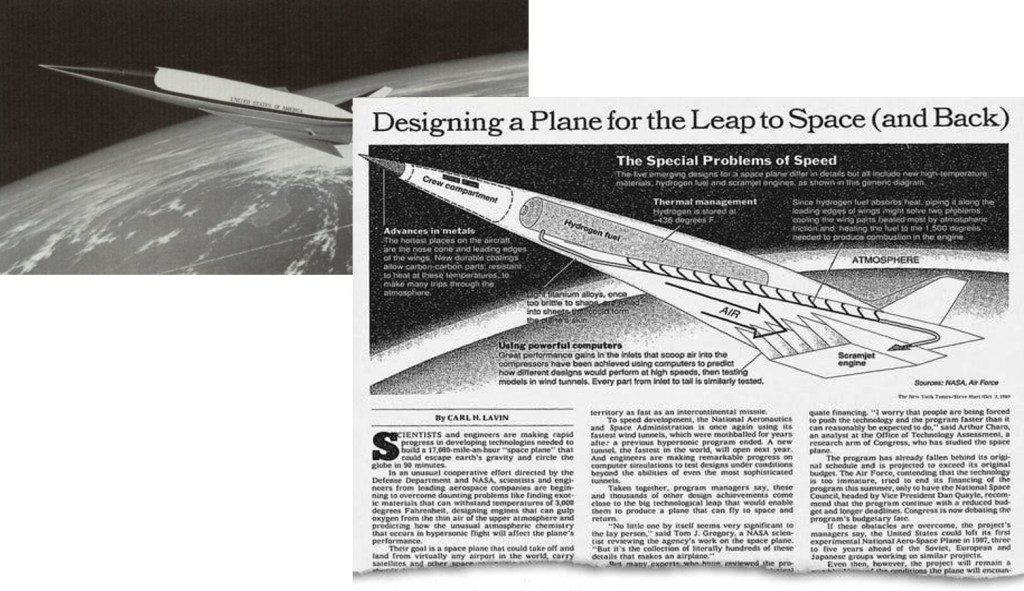
Some ancient history first. Only days after the loss of the Space Shuttle Challenger, a presidential speech kicked off the “new Orient Express,” spaceplanes that would take off from airports and reach space or Tokyo. At the time, the Space Shuttles were only five years old, and Atlantis still had that new spaceship smell. And here was an administration and later Congress telling NASA to work with the Defense Department to begin one of its many attempts to answer the question: After the Shuttle, what’s next? But was this the right question?
The National Aero-Space Plane (NASP), that Orient Express, would eventually admit to a bridge too far. Not just the materials or the propulsion technology, but computing, information, modeling, and simulation. My little exposure to this work came at the tail end of its cancellation, though hypersonic concepts would remain in the mix for years after. There would be SSTOs, X-vehicles, NGLT, NDVs, and SLI, and enough acronyms about what might follow the Shuttles that likely every three-letter combination was once a NASA future program. The history here would make for a door-stopper of a book, from single-stage, fully reusable rockets to expendable, modular launchers designed to be produced cheaply, to every variation and combination in between in scale and degree of new technology. After twelve years in the Shuttle program and about seventy-five launches, this became my full-time playground in 2000, working on teams to marry what had been learned to what comes next. We knew the Shuttle would not be around forever.
All this time, large expendable Shuttle-derived rockets remained on the radar, over in a crowd that looked to Mars, as a way to put up large fully assembled payloads. The cult-ish adoration of a big Shuttle-derived launcher argued that such a system could be developed rapidly and cheaply. (You see where this ends, right?) It was mostly Shuttle parts, after all, and critically, the same people, too. These concepts also emphatically tossed aside the winged Orbiters everyone pointed to as the cause of so much expense. Nonetheless, these expendable systems remained in the fray, with the thought that they would go alongside the other real advances. In the background of the next step. A complement at most, not in place of.
More years pass. Project after program after study after trade failed to take off, even as NASA lost its second Shuttle, Columbia, in 2003. This came seventeen years after losing Challenger, after those dreams of spaceplanes, of hundreds or thousands of people living and working in space, routinely going back and forth. As we said back then, the goal was routine, affordable access to space. But time ran out. NASA and Congress would now commit to a path ahead.
Until this point, it was generally agreed that human spaceflight had already tried a massive expendable rocket. The Apollo missions demonstrated that these were capable and possible. They also showed these systems were not sustainable. If, by the late 1990s, people blindly pointed to the Shuttle as showing reusability was unaffordable, another camp pointed to Apollo as showing expendability didn’t work either. What was a decision maker to do?
The shift to Space Shuttles after Apollo accepted that NASA must figure out how to reach orbit on a routine, affordable basis before pushing onward. This meant reusability, to the maximum extent possible at the time. You can’t throw away the plane after every flight and expect trips to Paris for everyone. A space station would make sense too as an intermediate step, perhaps as a point where parts delivered inexpensively to low Earth orbit could be assembled into larger spacecraft. The Moon and Mars could only follow after getting people to LEO became passe.
Soon, this knowledge would be lost.
On my arrival at NASA Kennedy Space Center, it did not take long to pause and ask questions after realizing that Shuttle launches were hardly routine or affordable. So many questions. What was the purpose of what we were doing every day? What was the plan? Not that everyone took the red pill, wanting to understand the nature of their reality. For the most part, blue pills filled jars like jelly beans on every desk. The Matrix was comfortable, the future uncertain. In retrospect, this is understandable, as the most relevant question about the future for most people is whether they are in it.
To make matters worse, NASA’s future projects mistakenly believed their purpose was the project itself, and that their goal was to develop that technology or a new launcher. These poor answers to superficial questions filled the void until realizing that the work in the years ahead was really about understanding the questions. What comes next? Sure, but also, who, how, and especially, why?
Two events come along to remind us that, while NASA human spaceflight has systematically been incapable of planning or looking too far ahead, the unexpected does happen. On the one hand, a small project begins shortly after the loss of Columbia to get grocery runs back up and running to the International Space Station (ISS). The Commercial Orbital Transportation Services (COTS) program reimagined how NASA partners with industry, avoiding paying for activity and instead paying firm-fixed prices for results. From the pittance of about half a billion dollars, ironically, an amount allowing the program to fly under the radar, arises the SpaceX Falcon 9 and the Dragon cargo spacecraft. From here will follow, mostly without NASA investment, upgrades to make the expendable Falcon 9 semi-reusable, a move that reinvigorated the US and global space industry. Right along with that comes the crewed Dragon and the Starlink business case underpinning it all.
A rocket like the Falcon 9 returning its first-stage booster, landing vertically, was not on anyone’s bingo card on the advanced projects side of the house (though some teams espoused vertical landing, architecturally in reverse, for orbital stages, while ditching the first stage, and others did look at winged “flyback boosters”). So much for the decades of studies, R&D, projects, and programs jostling to define what would follow the Shuttles.
Reusability would prove key for the Falcon 9, now leaving no room for doubt that the strategic emphasis on reusability in all the earlier NASA projects was and remains at its core, correct. But the sense that efficiency was key, not “what”, but “how”, in studies after 2000, proved lacking. NASA is not in the business of launching hundreds of times a year, and any analysis of efficiency had to be tied to “why” such a launch rate would occur at all. A “commercial” emphasis would connect here and survive, but by the time of the loss of Columbia, not much – except in that small program called COTS that no one paid much attention to.
Elsewhere, on the other hand, what leads us to SLS and Orion today is a 2005 NASA study that concludes that Shuttle-derived systems must lead the way, all fully expendable. And here we are, SLS and Orion, launched for the second time. Over twenty years later. Twenty years. Tough decisions explain much of this, decisions that will soon be around the corner again. Is NASA capable of learning from the past to create something wholly new, while also advancing its scientific mission? More importantly, can NASA move beyond projects, beyond “what” to a “why” that binds it all together? Would Congress approve, or does NASA’s human spaceflight remain a jobs program first and a scientific agency in name only?
Last month, NASA Administrator Isaacman announced changes to the Artemis program architecture, which includes SLS and Orion. Unsustainable cadence? Launching every few years does not make for a system that will ever be safe or affordable. Let’s work on that. Because after twenty years, someone finally admitted, “Launching SLS every three and a half years or so is not a recipe for success.”
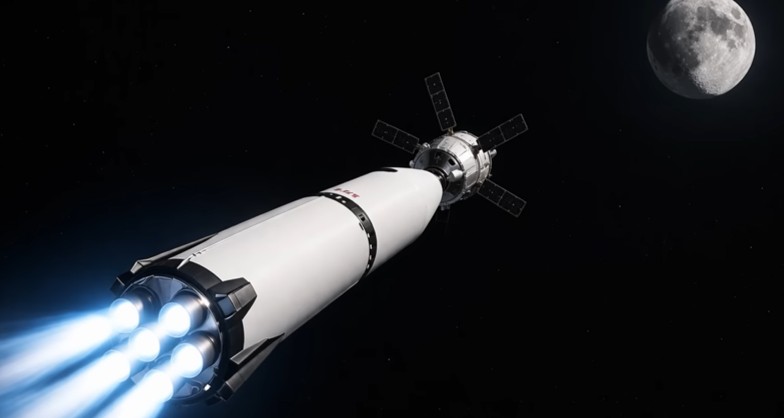
Shortly after, more changes are announced – the elimination of the Gateway toll in Lunar orbit, the cancellation of the new, larger upper stage for the SLS, and the possibility that Orion might meet up with its lunar lander in low Earth orbit, then leave together for the Moon, rather than meeting up in lunar orbit.
All these changes are hard realities finally crashing into NASA advertising, Congressional orders, and rocket design by voting districts. It only took a generation. We can, of course, mince years. Orion began as the “MPCV” in 2006, so NASA excludes billions of dollars in those early years because, well, the MPCV was renamed Orion. This made it a new project! This is NASA, Congress, its districts, and contractor workforces popping blue pills like Tic Tacs. The SLS fares only slightly better, also excluding five years (2006-2010) during which NASA carried along solid rocket boosters, engines, and other major contractors under prior plans. A cargo vehicle called the Ares V is renamed SLS, and voila, a new project, again.
If you can’t create the future, at least you can do new names.
Twenty years is a career for many NASA and contractor employees. If you began at NASA in the years after Columbia, you can count yourself as having spent your best years showing what does not work. Now proven not to be sustainable, affordable, or routine, we have a second data point other than the Apollo program.
Congress has finally passed a NASA authorization that would seem to give NASA some leeway to further investigate the hard limits of reality, rather than continue with SLS and Orion. Perhaps. But why not be clear?
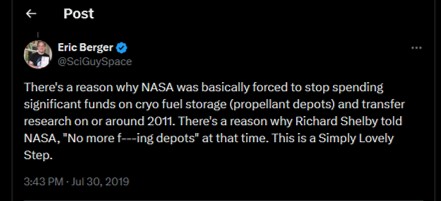
In a last-ditch effort to kill the SLS program in 2011, a small team considered alternatives, mostly about refueling in Earth orbit. They dared to develop plans, budget charts, and so-called “sand charts” that showed the SLS canceled, then other options within the same budget top-line. For this, they were roundly criticized, heads on a stake for some, with a Senator’s florid instructions to NASA – “No more f—ing depots.” A Senator. A Senator not liking that a team* showed budgets and costs did not match the NASA advertising about the Moon, and beyond. It didn’t add up then, and like the plumbing in an old house that needs to be entirely replaced, neglect and now duct-tape do not make it better years later. (*Full disclosure, I was the analyst joining the architectures, costs, and budgets back then.)
Why were SLS and Orion an impregnable fortress? Jobs. This remains the difficulty today. An honest assessment of the recent shifts, a Gateway or an EUS canceled, would see these as nibbling around the edges of the problem. A couple of hearty bites, at most. The real problems remain that stand in the way of NASA playing any role in the expansion of human activity throughout our solar system. The ability of NASA to carry out its true mission, to advance scientific knowledge, and for humans to explore space, remains moored at the port, chained to SLS, Orion, and many more parts and pieces of the Artemis program. SLS/Orion is a constituency with rocket engines, nothing more. Ending these engineering atrocities entails the same difficulties we ran into back in 2011. The list here will quickly reveal the scope of the challenge:
1. Shut down the Michoud Assembly Facility (MAF) in Louisiana, where Boeing produces the SLS core stage. A difficult one. About a thousand direct jobs, many more indirect. Terminated.
2. Shut down the solid rocket booster work by Northrop-Grumman in Utah. This one is easier, as NG has ample prospects with their current contracts to produce a new generation of nuclear missiles. If you know how DOD accounting works, their auditors won’t even notice the additional few thousand employees transferred from the SLS. When they do notice, they won’t care.
3. Shut down the SLS rocket engine project at Rocketdyne in California. Some more thousands. As this eliminates the company’s primary revenue stream, it will likely cease to be a going concern.
4. And the two items few realize: at Marshall Space Flight Center in Alabama and at Kennedy Space Center in Florida, all indirect support must be terminated quickly to free up significant resources. Tens of thousands of jobs. (The left of the pie chart that follows.)
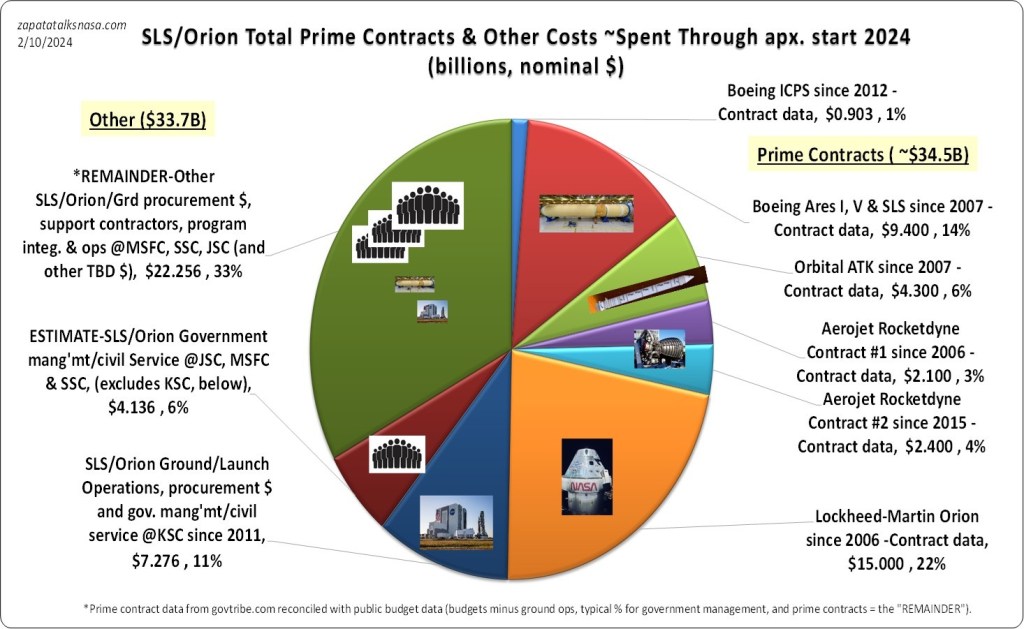
Yet, no list of human costs, disruption, or trauma is complete without understanding why this is both inevitable and how it might still end well. How everyone can be part of a future worth embracing.
Assuming (a big assumption) a NASA human spaceflight top line is the same as with SLS or Orion, their demise is not intended to have NASA simply turn into a smart buyer of rides. We would be no closer to answering the real questions or finding our way back to the plot.
Rather, this is the opportunity for NASA to rebuild its R&D base in human spaceflight, to properly segue away from the ISS toward new LEO installations, to connect LEO to going further, to staying, and to imagining possibilities for which there simply is no air in the room right now. And every day that avoids this admission, that it must all “add up,” is a day away from any Moon mission that gets us there to stay, to build, and to grow our human presence.
Just the other day, amidst all the changes afoot, NASA notified industry that it will be adjusting course in its Commercial LEO Destinations (CLD) program. For a long time now, NASA has been figuring out what comes after the ISS as much as it once thought about what comes after the Shuttle. A chance success may occur, the unexpected, as with a Falcon 9, a Dragon, and a Starlink, except none of those occurred by chance. They occurred by investing, by trying one thing, then another, as well as by provident circumstances. Failures are an option, trying programs large and small, sane and insane, and trying again.
A success for what comes after the ISS would look like a facility that no one expected could be so affordable to operate, except for the crowd (once they see success), saying they knew it was a good idea all along. It would also include, as with Starlink, a product, something other than zeros and ones, and that ordinary people are willing to pay for – perhaps materials, perhaps medicine, or something we can’t imagine. Something made in space. Or bought from space. Then more after that, stuff from a long list of possibilities. Rather than see the end of the ISS as a piggy bank for Moon missions, an honest assessment of what goes under a budget line would admit that a vibrant LEO economy is what will allow Moon missions to continue and grow.
Similarly, NASA R&D is a shadow of its former self. The Space Technology budget line many would point to in reply is now tasked with working on what is merely farther away. R&D is something else entirely. R&D is a start-up centered on creating knowledge, with no particular link to a race, a schedule, or a foreseeable project need.
Visualizing what is happening is not difficult. The current path was unsustainable, incapable of delivering what it promised, given NASA’s budget limitations. Every year, delay became the easy fix, squeezing the costs under the budget “red line.”
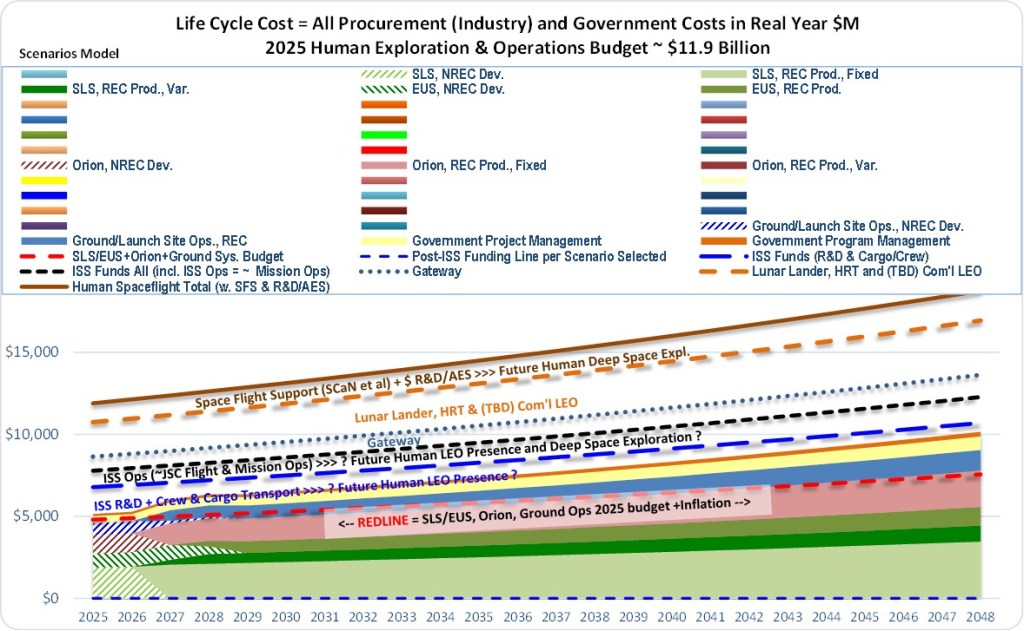
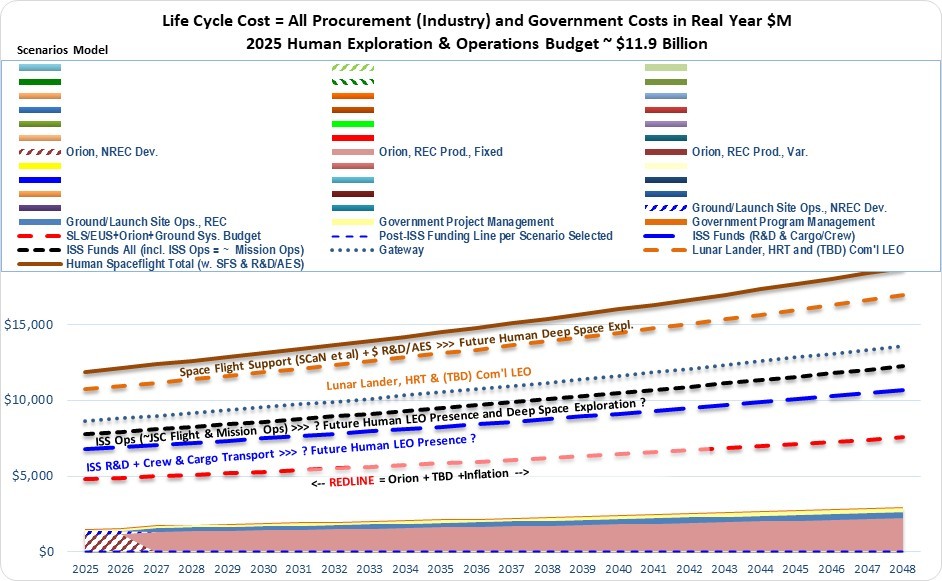
Of course, this is not, in the end, about models and sims, sand charts and rockets, re-establishing R&D lines and re-enforcing LEO lines, nor about endless options to mix and match Blue Origin and SpaceX launchers, spacecraft, spacesuits, outposts, and rovers. It’s not only about NASA getting back to the work at the pointy tip of the spear, spaceplanes, new materials, depots, reusability, or propulsion, nuclear and otherwise. Endless technological and architectural possibilities are, fortunately, a good problem for NASA to have. It’s not about economics, either, markets, or costs versus budgets, or reality checks about what adds up vs. hand-waving when the only things that add up are the years gone by.
Is it all politics then? For sure, this cannot be ignored. Because the politics about jobs first, and science and space exploration – wave flag, astronauts, so cool, China, word salad, a race, mumble, be awed and be quiet – is obvious, if discomfiting.
But there remains a truer cause for how NASA got where it is today. The cheering, the excitement, the sense of a turning point. If I can say so, from my years in the Shuttle program, then in too many advanced projects, too many studies, and too much cool new hardware sent to the dump. It all began by forgetting to ask “why” NASA exists. If there is to be a NASA in the future. NASA exists to embrace and create a vibrant future for humanity, where Earth remains our home but the solar system is our backyard. Project after program after shift can’t be about preserving the past, like SLS/Orion, or about desperate measures to survive, as when adjustments finally arrive on the doorstep. Congress has given NASA an inch. Now it’s time to take a yard.

 Zapata Talks NASA