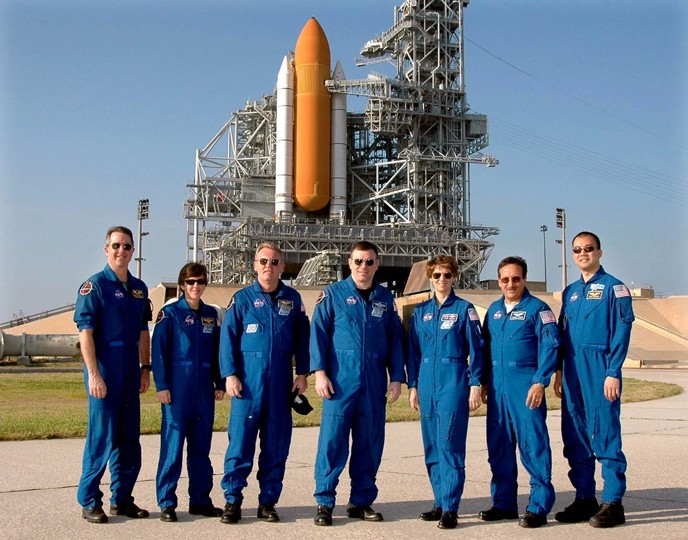
In 2005, NASA astronauts were a couple of months away from launching aboard the Space Shuttle Discovery. They would dock at the International Space Station and deliver supplies, but the real purpose of the mission is to evaluate new safety measures. The Shuttle’s thermal protection systems would now be inspected in orbit after every launch. Before, this was not the case. On the previous launch in 2003, significant damage to a wing went undetected, leading to the catastrophic loss of the Shuttle Columbia.

Two and a half years later, aboard this “return to flight” mission, is astronaut Dr. Charles J. Camarda. He is expertly familiar with the Shuttle’s thermal protection systems from his research days at NASA’s Langley Research Center, and he has traveled a vast distance from innovation, understanding, and research to experience space travel firsthand. On his return from space, he will take another journey into the world of Shuttle operations. It is here that a different kind of story emerges, leaving behind the familiar and simple space exploration tropes about tough can-do commanding personalities overcoming technical challenges and the unforgiving environs of space, paving the way for a future that is a little better every day. This is not that book.
Instead, here begins a personal story…
Instead, here begins a personal story about an individual surrounded not by the inhospitable vacuum of space, but by the machinery of a vast and malfunctioning organization, NASA, seemingly no longer able to pause as its gears grind forward regardless of warning signs that the bridge ahead is out. This is a story about dysfunction and the limits of a culture built on “biased reward systems.” Here, the normalization of deviance has become the only norm.
The title says what’s in store, in NASA we have “Mission Out of Control.” However, this is no ordinary expose, a collection of interviews and research by a reporter versed in the subject matter, stitching together someone else’s stories. This narrative is unfiltered, the lived experience of the author likely to leave any reader with a sense, “You can’t make this up.”
Camarda is a native New Yorker, catholic high school, dreams do come true astronaut, who went from on high deep into ground zero of NASA spaceflight decision making–as NASA engineering director at Johnson Space Center. To launch or not to launch, safe or unsafe, sound or unsound, evidence and logic, or not? Technology, people and the mish-mash culture they form are the recurring backdrop.
Camarda makes many points to great effect. For one, regarding technology and the difference between what is merely complicated and what is complex. A building, a car, even an airplane. These are complicated by many measures. Parts connect and interact, and there are so many parts and so many interactions. The Space Shuttle, Camarda points out, was something else entirely. It was complex. Never fully mature, never truly operational, with plenty of room for more understanding, and deserving of a healthy dose of continuous inquiry, research, and caution. Look at the Shuttle’s wing leading edge, and you will see Reinforced Carbon-Carbon, possibly mistaking this for an advanced space-age material. A correct and respectful appreciation of the wing panels recognizes that it is a material system.
There is ample technical detail of this sort in “Mission,” but the shortcomings in NASA lie not in a material system or the interactions of foam, structure, and aerodynamics. It’s not about a poor booster O-ring design and failing to understand aging hardware. Though a reader will learn all about these in great detail. Rather, as the saying goes, the fault lies not in our stars but in the state of culture within NASA human spaceflight.
In 1988, my required reading at the Kennedy Space Center included the Rogers Commission report and the book “Challenger: A Major Malfunction,” where I learned about heated conversations before the launch of Challenger. Some of the irrational replies to the plain data included “My god, Thiokol. When do you want me to launch? Next April?” In Camarda’s account of events before the loss of Columbia, the steamroller comes out again as we hear, with the possibility of a damaged orbiter in space, “There isn’t much we can do about it.” In the lists of NASA’s lessons learned, the saddest part is hearing once again a confirmation that all that may have been learned between one tragedy and then another is helplessness.
…Camarda’s account is a call to arms…
“Mission,” apart from its astute technical and organizational storytelling, may be all about a journey at heart, though not to space. Care enough to adventure out of the ordinary, and before you know it, you will be tested. Do you speak up? This is the proverbial inmost cave, a decision to enter into a realm wholly unlike the one you left.
Read this way, Camarda’s account is a call to arms not only to understand complex technical systems, but also how complex organizations fail. Both worlds march together, and one will not progress without the other.
This leads to a final note, as NASA proceeds into Artemis II, the first crewed flight of the SLS and Orion. Yes, that Orion, the spacecraft with the thermal protection system that performed poorly, in a way not completely understood and expected, on its previous uncrewed test flight. The Orion that flew without other systems on that flight, too, like life support systems. That Orion, that does not plan to fly a complete and fully successful spacecraft before launching with a crew. That Orion, which will not have been given another uncrewed shakedown flight around the Moon. Once again, as in “Mission out of Control,” we see the political pressures to launch, at odds with a sense that it’s purely technical readiness that determines when NASA places lives at risk.
But a reader will ask, why tell these stories at all? It starts with a daring honesty from Camarda. The assumption is that someone must listen. After all, NASA is worth saving because it is tasked with exploring our world, leaving us all the better for it, and how could such a purpose not be worth fighting for? Optimism is also in NASA’s DNA, as in this book, a sense that NASA must be fixed, not because we are all on the same ship, but because the mission is worthwhile, and the crew, for all their flaws, are our friends.
Challenger. Columbia. For Orion, time will tell. As Twain said, “History may not repeat, but it rhymes.”

 Zapata Talks NASA
Edgar, I really enjoyed reading this! Thank you, Frank
LikeLiked by 1 person
It’s a great book I truly believe so many in our aerospace community should read. Otherwise NASA lessons are told and written down but not learned.
LikeLike