This will sound suspiciously improbable, a story that changed hands too many times, becoming colorful Kennedy Space Center folklore. Unlikely, and untrue. Not so, as my story here today comes first-hand. I was there. Once, at Kennedy Space Center, I was fighting a raging fire. This was a real fire, a blazing two-story fire at a gasoline tanker truck.
It was around 1989. The date for this story from far back in the memory shelf is set by the Hubble Space Telescope, launched in 1990. Recently hired at Kennedy Space Center, we were told to go off to “fire training.”

We should arrive in clothes we can discard, and be prepared to get covered in a fine coat of grime and sweat. It’s a short drive, toward the Cape Canaveral Air Force Station, but still Kennedy property. I turn onto a side road that leads to seemingly nowhere. Sandy, Florida scrub, heat, humidity, and a dustiness covering every car, piece of equipment, and soon us. The center of attention is a toxic pit of brackish muck surrounding a burnt tanker truck that will soon be burning again. A holdover from who knows when, perhaps a vestigial appendage of Apollo days, certain employees are required to train on how to put out a massive fire. The names on this training list must have assumed it’s the engineers who are expendable.
Today, we are told that we will, one, bond as a team, and two, put out a roaring fire that was intentionally set.
You can’t make this up.
My office mates and I are scheduled together, as we often were for training, but today it is so we can learn how to handle full-scale, full-pressure, genuine fire hoses. We are about to put out a conflagration. These are not garden hoses. These are the genuine article, of the fire-department kind. Bring up the pressure on this hose, and if I were holding the hose alone, or even someone twice my weight, chances are you would get an out-of-control hose whipping around dangerously in all directions. Controlling the hose requires at least a few people. It takes a team.
It’s the space hardware that finally forced someone to ask if intentionally setting fires was a smart thing to do regularly.
This training requirement (and all the fun we had, admittedly) came to a halt with the realization that the Hubble Space Telescope would arrive at the space center the following year. The last thing the optics of a space telescope need is a persistent, low-hanging fog filled with fine particles of soot. Forget the environment, and that people breathe in this air. It’s the space hardware that finally forced someone to ask if intentionally setting fires was a smart thing to do regularly.
Years later, people reminisced about this training and inevitably asked, “What were they thinking?” Kennedy is a place rich in unofficial acronyms (like BFRC, not in the official acronyms book) for atmospheric events one is instructed to flee from at speed. “Run” is the entire procedural guidance. Yet fire training demanded the opposite. Now it was stay, hold your ground, wrestle with catastrophe, demonstrate heroism. You get used to institutional contradictions at NASA, but this one had range.
The mindset of firefighting has many layers, the first being operational. Firefighting means fixing the problem of the week. It’s always something. Then there are the blazing fires, the urgent crisis perceived in the leak or the valve, which holds up a Shuttle launch. It’s always a valve. A second layer to firefighting is that once pressured by time, it’s easy to lose sight of any deeper understanding. The gadget failed because of a damaged seal, so easy enough to fix, but forgetting to ask why the seal wore out so soon in the first place. Thinking suffocated by these layers of plastic wrap imaginatively gets past the logic gates to heroically fight a fire, to say “Yes, launch. Here’s my flight rationale.” Medals and awards are forthcoming soon enough. Understanding, not so fast, or as appreciated.
The mental acrobatics of operations can easily land a ten-pointer, creating wordy flight rationale that sells.
The Physicist Richard Feynman, on the Rogers Commission following the loss of Challenger, famously tore through poor operational obsessions where everyone is “Go for launch.” At one point, he discovers NASA asserted a safety factor of three for O-rings, because, sophomorically, erosion by a third did not cause a failure. The mental acrobatics of operations can easily land a ten-pointer, creating wordy flight rationale that sells. Similarly, after the loss of Columbia, we discover a flight rationale that because crumbs of foam did not cause appreciable damage on prior flights, the briefcase-size piece of foam (or ice, or snow, or all of these, we will never know) was not a big deal either. Models and busy charts with tiny fonts claim this is so, confusingly, so even better.

This last layer of confusion is the spice of operations enabled by techno-gibberish. A specialized discourse is used throughout Star Trek: The Next Generation. Writers found a useful way to fit stories into 45-minute time limits by having a crew member earnestly state something inspired, but unintelligible, about deflector shields, harmonics, and EPS conduits. It’s the 41-minute mark. 3, 2, 1, Go for Warp! In the real world, this technocratic discourse serves as a means to restrict communication to only a select cognoscenti, who are overly mindful of their territory.
…beyond techno-gibberish.
But there have been upgrades. We now have a next generation beyond techno-gibberish. We have black-boxes. The redacted Orion heat shield report is history repeating itself, minus the nonsense charts. No one can stand up now and say one bullet is inconsistent with another. Or the object in question is hundreds of times the size of the ones used to validate the model. Now we have nothing – except stretch after stretch of black boxes covering who knows what. The Shannon entropy is strong with this one, NASA’s ability to forget past lessons, learned tragically. Transparency is one such lesson, regardless of what’s behind the curtain.
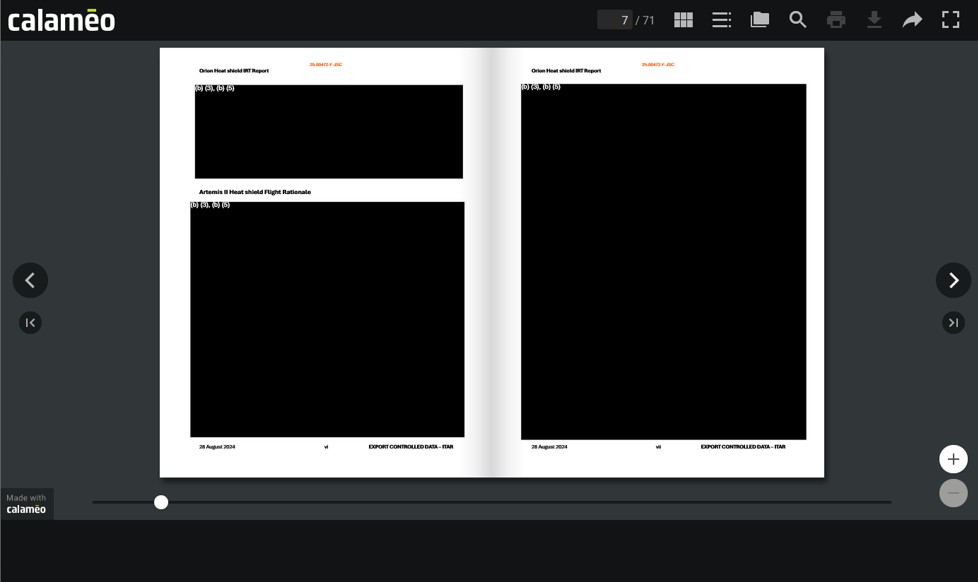
The uncrewed Artemis I flight of the SLS rocket and the Orion spacecraft should have shown an understanding married to a successful operating demonstration. Instead, NASA got an Orion heat shield shedding a hundred chunks of Avcoat. It takes a NASA IG report to reveal this problem, two years after that flight. Rather than fix this issue on the upcoming Artemis II, with crew aboard, what do we have? Flight rationale to fly as-is with what is a nearly identical heat shield on Orion as used in Artemis I. After all, time is pressing.
This is not the first time I’ve been compelled to write about the Orion heat shield, nor am I the only one seeing this. NASA’s flight rationale, that black box in a report, or a whole page online, changes little.
The intent of the Artemis I uncrewed mission, which involves a sound understanding of the design as it will be when carrying a crew, combined with a successful flight experience, has not been met. Artemis II should launch without crew, placing the currently assigned crew on to Artemis III, assuming a successful Artemis II. Considering NASA’s SLS and Orion can end up awaiting the SpaceX Starship lander, right now appearing to be the long pole toward a lunar landing, nothing is gained by placing crew on Artemis II. Though possibly, everything is lost. It remains to be seen if another famous chart makes it into another book that’s required reading for NASA new-hires.
The intent of the Artemis I uncrewed mission, which involves a sound understanding of the design as it will be when carrying a crew, combined with a successful flight experience, has not been met.
I admit, I am betraying my operational roots. But after twelve years of Shuttle launches, I was fortunate (or ill-advised enough) to move on to a career dwelling on what’s next. What research and technology must follow, based on all that old hardware, all it told us, reluctantly, about the reason behind its failings. It couldn’t all be firefighting after all, with that bias to think not launching till we really understand what’s going on is not an option. We were told to avoid “launch fever,” but it seems for NASA the R-nought is way over 1, and no vaccine has proven effective.
Unfortunately, NASA again seems poised to have people ask, “What were they thinking?”

 Zapata Talks NASA
Awesome article, Edgar! Your writing is fantastic too. It was a pleasure and easy to read with an important message.
Warm regards,
Lynn
Harper, Lynn D. (ARC-DI)https://www.linkedin.com/in/lynn-harper-95700833/details/experience/
650.448.3267
Strategic Integration Advisor to the International Space Station National Labhttps://www.issnationallab.org/
Strategy Lead for NASA ISS InSpace Production Applicationshttps://www.nasa.gov/mission_pages/station/in-space-production-applications
Lead, Integrative Studies for the NASA Ames Space Portal/ Office of the Director Partnership Divisionhttps://www.nasa.gov/ames-partnerships-office-annual-report-2023/
Technical Monitor, ISS InSpace Production and Applications flight projects (supporting NRA NNJ13ZBG001Nhttps://nspires.nasaprs.com/external/solicitations/summary!init.do?solId=%7b21E0270C-BC1F-EFC4-3D87-30713B5FF373%7d&path=open and SBIR Focus Area 22https://sbir.nasa.gov/)
Make sure to put a better idea on the table when you have one — or a worse idea will be implemented.
Identify all the valuable aspects and things that are working well BEFORE identifying all the things that need to be fixed so that you don’t damage or destroy a more valuable asset in order to fix a more trivial problem.
Decision makers can’t make informed decisions if they are not informed.
LikeLiked by 1 person
Thanks Lynn. I have forgotten most of how to talk and write in the techno-babble I was once so well trained in. Thankfully. Maybe a message gets across.
LikeLike