Imagine a world turned on a very peculiar lathe of heaven where risk cannot be measured. A sure-footed step and a dangerous ledge share the same outline. Robust designs look no different than those balanced on assumptions. A schedule measured in months is indistinguishable from one that could slip into years.
Here, uncertainty flourishes. How would anyone make choices in such a world? We would all be small boats caught up in large, unpredictable waves. Best accept the limitations of our existence.

This is close to the world of advanced aerospace projects. Except here, we do not have the luxury of resigning ourselves to our circumstances. Fortunately, if risk is like dark matter, not quite clumping together into detectable bodies, there exists indirect means of grappling with risk.
Ask about the benefit.
Debates about risk must also speak about the potential upside. The commander of the Pacific fleet, C.W. Nimitz, expressed this best in the lead-up to the battle of Midway. He ordered the task force “…be governed by the principle of calculated risk which you shall interpret to mean the avoidance of exposure of your force to attack by superior enemy forces without good prospect of inflicting, as a result of such exposure, greater damage to the enemy.”
The benefit was in the same breath as the risk. More so, here the benefit must have “good prospect” of being greater than the risk.
If fiction ever expressed this quite as well as Nimitz did in real life, it was Captain Kirk, and the memorable line (Channel Shatner’s voice as you say this.), “Risk… that’s why we’re aboard her.” Less likely to be remembered is the other line in Kirk’s speech, “But I must point out that the possibilities, the potential for knowledge and advancement is equally great.”
Potential benefits and potential risks. Where one moves, the other follows. Risk, benefit. If one is in doubt, look to the other.
As the Artemis II mission approaches, debate continues to center on risk. Artemis I was successful, but not uneventful. The Orion heat shield exhibited unexpected behavior, with hundreds of sizable pieces flying off during reentry into Earth’s atmosphere. Also, Orion suffered electrical anomalies left and right. These were not failures, but they were not trivial either. Artemis I was also incomplete by design, as Orion flew without an active life-support system. Artemis I was neither a full nor a complete success, an uncrewed duplicate of Artemis II, doing so well as to justify putting a crew on the next one.
Critically, Artemis I was the only fully integrated flight test of SLS and Orion. One launch. One data point. There is little historical comfort here in trying to huddle around a host of data points. The only NASA human-rated launch system with fewer uncrewed test flights than SLS/Orion was the Space Shuttle, which flew zero. If you look at all other US launch systems, past and operational, the sole SLS/Orion test flight fares even worse.
The debate about the crew aboard Artemis II, which is unfortunately not as widespread in the public consciousness as it should be, tends to lean toward seeing the benefit of winning political points. Between the lines, any mention of political pressure is about a benefit, pleasing the stakeholders who provide NASA with its funding and determine whether you will remain in your job. This for putting crew on a mission that does not land on the Moon. It is easy to see the even greater political pressure to land on the Moon during the current administration (executive “orders” and all). What could go wrong with technical decision-making in such an environment?
- January 30, 2026, “Safety concerns raised ahead of historic Artemis II launch,” Good Morning America/ABC News
- January 30, 2026, Longer segment, ABC News Live Prime, starting at 30:30, here.
- January 23, 2026, “NASA is about to send people to the moon — in a spacecraft not everyone thinks is safe to fly,” Jackie Wattles, CNN
- January 16, 2026, Anthony Colangelo podcast with guests Eric Berger, Senior Space Editor at Ars Technica, and Casey Handmer, Founder of Terraform Industries
- January 9, 2026, “Is Orion’s heat shield really safe? New NASA chief conducts final review on eve of flight,” Eric Berger, Ars Technica
Is there a way to square this circle? Perhaps. And in a way that brings along the near-term benefit of progress now, technical or otherwise, and even more benefit later, to reliability over the life of the SLS/Orion system. The trick is to realize that flying is good, and not flying is…not good.
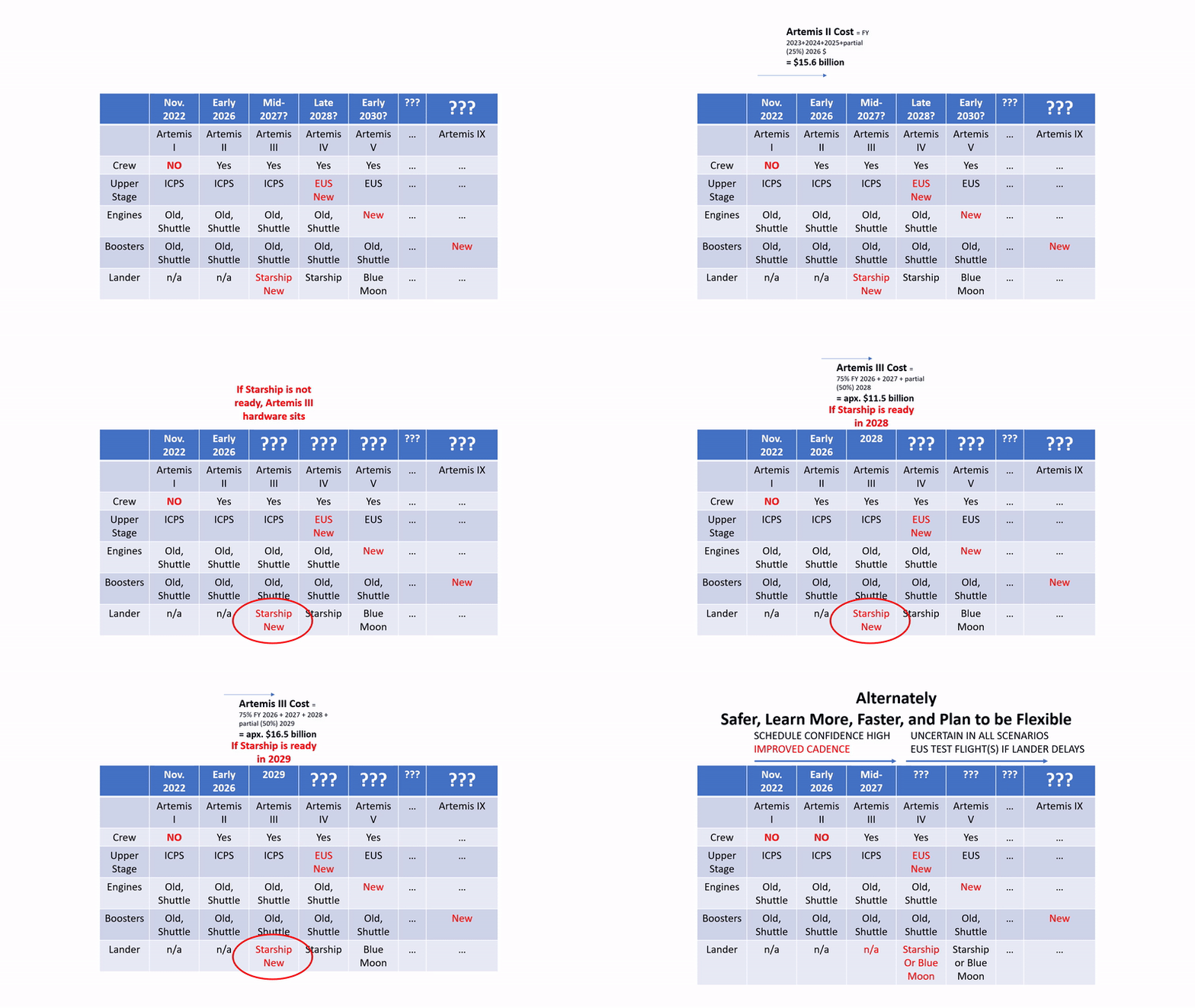
To see this possibility, we can tabulate NASA’s Artemis milestones by time versus hardware. Running out of old Shuttle engines? A milestone. Running out of Interim Cryogenic Propulsion Stages? Another milestone. In this view, the scenarios become much clearer. (Tables have a way of lighting the path ahead, as when tabulating the uncrewed test flights of other human spaceflight systems.)
A “use them or lose them” mindset admits that every year of delay between Artemis flights adds another $4-5 billion to the costs of that next flight. This is obvious, if, for uncanny reasons, it’s debated as if there were some alternative math where 4+4equals 4. But aside from the triviality of money, each year without a launch is a year in which the launch crew at Johnson, Kennedy, Marshall, and other spaceflight centers gets rusty. The longer the time between flights, the more unlearning will happen. This threatens long-term safety and reliability for SLS/Orion. If hardware is on site at Kennedy but, say, a lander is not, and more hardware is in flow, only the most ineptaccounting would say it’s too expensive to launch until a lander is ready. And only an insane view would see launching more as a risk, when it’s launching less that’s the problem.
Here (as written about in more fuzzy terms before) is a view of such a shift, in schedule and in mindset.
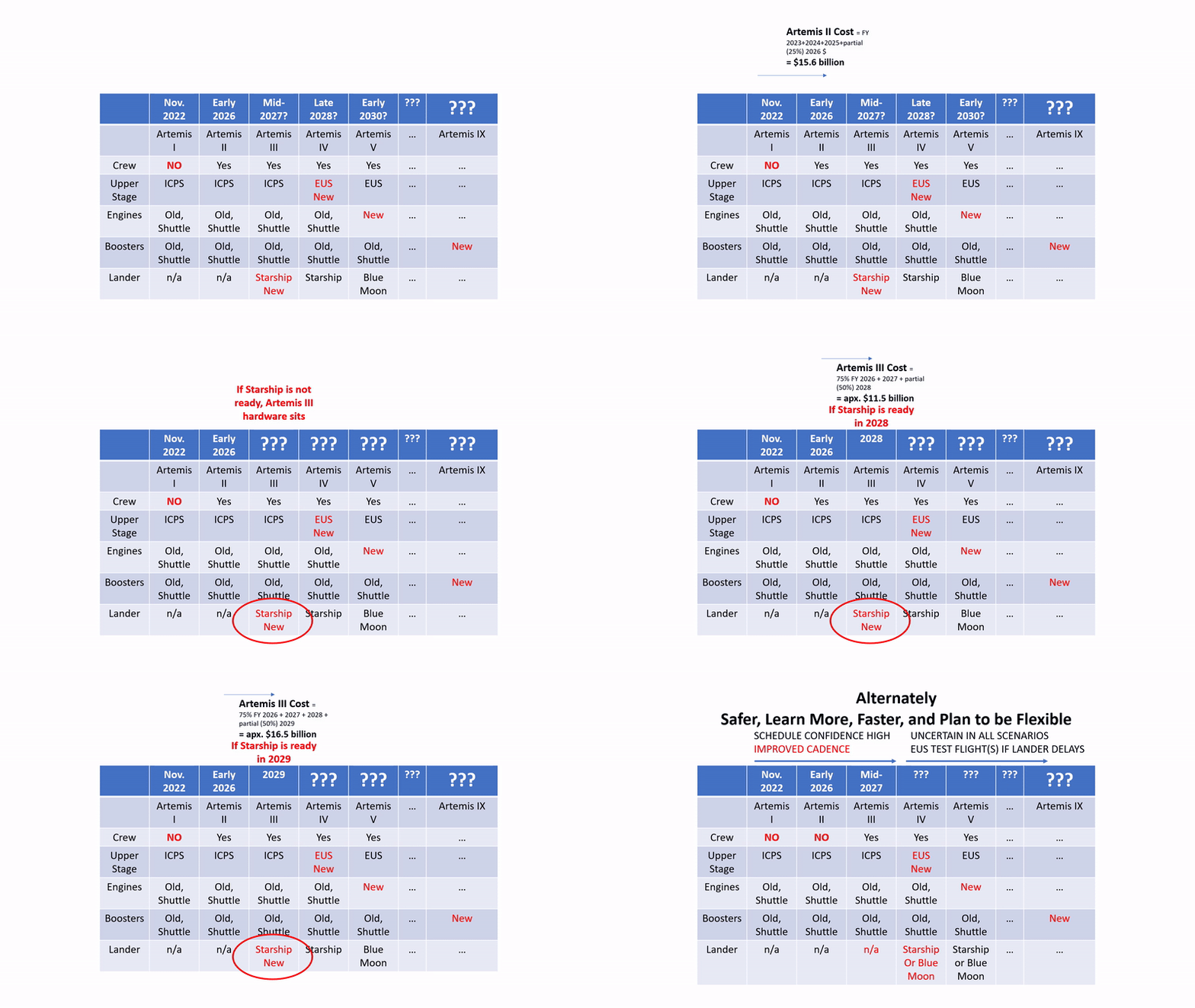
First, Artemis II launches without a crew. Soon. Artemis III launches by the Holidays or soon after, early in 2027, satisfying any stakeholder sense of lack of progress. Two launches have now taken place by early 2027. Not one. Artemis IV, well, that likely awaits a Starship, and if not, a shakedown cruise for the new upper stage, the EUS, launches instead.
Finally, the flight to land on the Moon places both a SpaceX Starship lander and a Blue Origin lander in play. Whoever is ready first gets that launch, the return of astronauts to the surface of the Moon.(Landers must also undergo uncrewed test flights, landings, and so on, to the Moon.)
Alternatively, the current plan, where Artemis II takes a risk, here and now. But, even if good fortune favors the day, Artemis III hardware would sit, awaiting a Starship, for possibly years. (Barring someone inside NASA finally saying, “…we might as well use them, or…”)
So, rather than accept we are carried along in a small boat in a raging storm, or having nothing to say when asked, “What would you do, what do you suggest we do?” here lies a solution. Satisfy certain “stakeholder pressures?” Check. Improve reliability growth? Check. A cadence of launching that helps the NASA team learn by doing, rather than by analyzing? Check. Improved safety (an uncrewed Artemis II)? Check. Marginal if any reality-based budget effects? Check. A sense of more happening, progress at NASA, over time, vs. less? Check. Not sitting around waiting on landers, which are likely long poles? Check.
Or NASA could proceed as planned. A large risk for a small return, a crewed flight advanced only a year or so. This significant risk is taken to show resolve, but it is not exploration. It is primarily a gesture for stakeholders. What matters is whether we are flying people around the Moon because it meaningfully advances the architecture.
History will know the difference. Even if, for a while, we pretend not to. Or we pretend that 4+4 equals 4.

 Zapata Talks NASA
As always, incredibly well written and presented. Love to read your takes, Edgar. Dr. Pat SimpkinsConsultantSpace Flight Ground Systems, Operations, Systems Thinking, and Passionate Leadership Development patricksimpkins@bellsouth.net(321) 544-5828
LikeLike
Thanks Pat. It’s good to hear from you!
Curiously, I wrote this one off the cuff, a morning, then another. (Had many typos when I published, since fixed.) I only say this because I think the less I think about it, the more people say they enjoyed a piece. Funny huh?
But this is serious stuff. I truly hope all goes well on Artemis II, with the crew, but I think the concerns raised by myself and others are quite valid. Only one test flight, Artemis I, with surprises, and incomplete. If this were a commercial provider, NASA would ask for a repeat uncrewed flight test. Too little transparency, too. SLS/Orion are far from the days of Shuttle when we published everything, more than anyone in the public would ever want to know. We “overshared,” in a good way.
I could go on, as you can tell from my recent posts. There is no lack of evidence that SLS/Orion is a system that’s painted itself into a corner. Finally, I figured, perhaps there is a way forward? Hence this post.
LikeLike