Inflation. It’s been in the news a lot for some years now, in the couple of years after the pandemic, when it was especially high, in the relief of dropping after, and now rising again with the US/Israel/Iran/Lebanon, and everyone else in the Middle East, conflict. But inflation is about much more than business, politics, or war. It’s about more than gasoline or energy prices. Inflation is an everyday part of people’s lives, everywhere across the globe. This is about affordability. In NASA, too. Which reminds me of a story.
I sat across the conference table, making various points about the NASA inflation indices and the rates we were told to apply when converting dollars from one year to another to make them comparable. I must have gone on too long about the inadequacies of the NASA indices, their disconnect from the realities of aerospace and R&D, and how NASA’s procurements had little to do with the broader economy on which the indices were based. About how adjustments to tune the indices around aerospace were marginal at best, that rockets are not airliners. I could have kept going. This may have been seen as disrupting the meeting, a meeting everyone probably wanted to wrap up. Minus the time to think through what our numbers really meant, that is. So, to stop me, or to put me in my place, or both, someone says, “Well, sure, and would you like to go toe to toe with OMB on that?” I should have said, “Can you set up a meeting?” but I did not. The discussion returned to fiddling with numbers that accounted for everything, including inflation, while entirely missing the point.
Even by the numbers, applying the official NASA inflation indices, NASA has lost 24% of its purchasing power since 1995. A dollar Congress provides to NASA today can buy only about three-quarters of what it could buy thirty years ago.
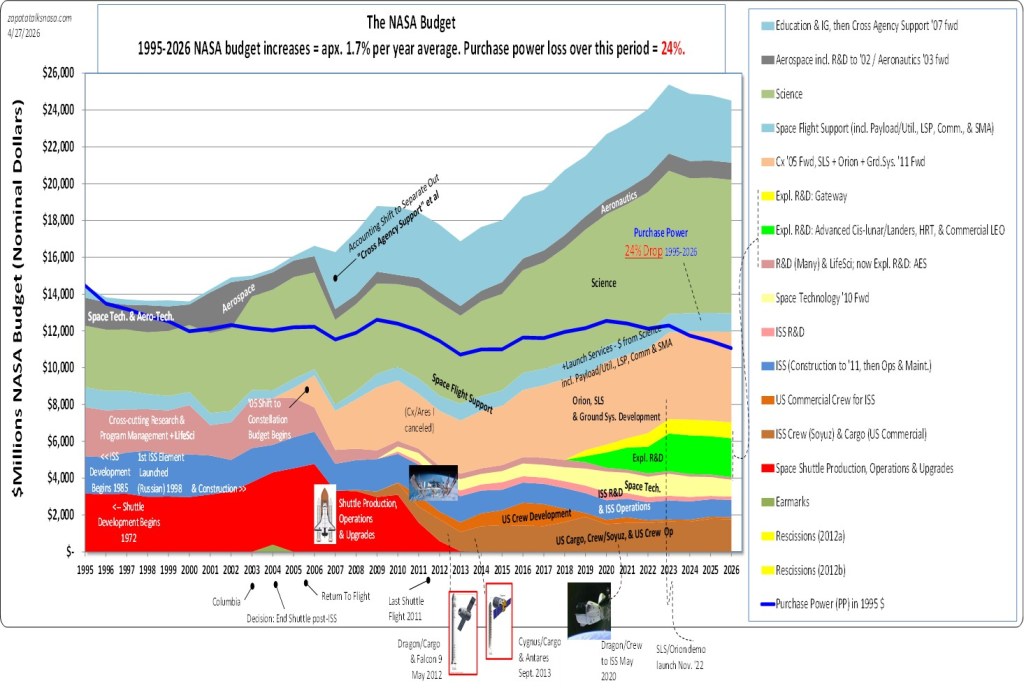
Now, can you imagine the real loss in purchasing power? NASA’s purchasing power has declined by at least 24% since 1995. And it is likely much worse.
If you nerd out on such stuff, you have likely seen data showing that the costs of education, healthcare, or housing have shot up, while the price of gadgets keeps dropping. But you don’t need to see graphs, comb through data, or read endless Substacks to know this. You also don’t need to see where the holes are to appreciate that inflation figures have become political, complicated, and divorced from everyday experience. Monthly inflation reports from the Bureau of Labor Statistics (BLS) are reality-challenged. And, like NASA, when it comes to anything related to cost or schedule, the BLS reports begin with optimism and get worse from there.
Naturally, if the BLS is going to publish a number that says so much about daily life every month, then those poor civil servants were going to get into a fix. More data, always useful. More information than we could ever imagine, great. But then, too, it’s often bad news. So the pressure to cook the books was inevitable, meaning low means not that high, and high means very high and all the more hidden behind techno-babble. Turns out, NASA’s challenges with honesty about costs cross agencies.
Daily travels encounter this curiosity about the BLS’s inflation calculations. The BLS adjusts pricing for electronics and much technology further down than even the price reductions they honestly achieve. After all, the quality has improved so much. The picture is sharper, the TV is thinner. But for air travel, well, the BLS will not adjust the cost of a seat upward for fewer cubic inches of space or poorer service. If you want to explore this concept, push the little button on the overhead panel to get the flight attendant’s attention. In 1995, more coffee, a smile too. In 2026, you may get armed TSA agents waiting to escort you off the plane at your destination. Try it.
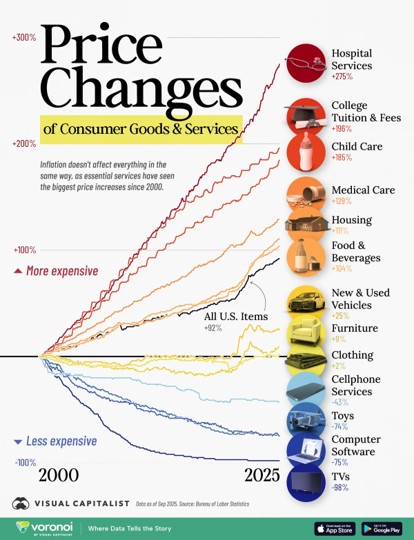
So, as has been said often, if everything people want has become cheaper, but everything people need has become more expensive, where is NASA in all this? For NASA and for aerospace technology, what are our needs and wants? A quick retort will say, “SpaceX!” observing that the price of a Falcon 9 is much less than previous launchers. But NASA is a lot more than Falcon 9s, and there is a distinction often lost: costs are not prices.
The advent of the Falcon 9 has entirely changed the aerospace market, making it attractive to investors on a scale well beyond the sleepy days of Space Shuttle launches. But the data also show that market elasticity at cost is one thing, while at price it is much less notable. If you are SpaceX, launching Falcon 9s at cost, the market has proven very elastic, with demand, yourself, and Starlink showing up as customers for your own supply of launchers. This is elasticity as a payload demand effect arising from lower-cost launch supply – the business case not closing at a higher launch cost. At Falcon 9 prices, though, market elasticity also shows flex, just not so much.
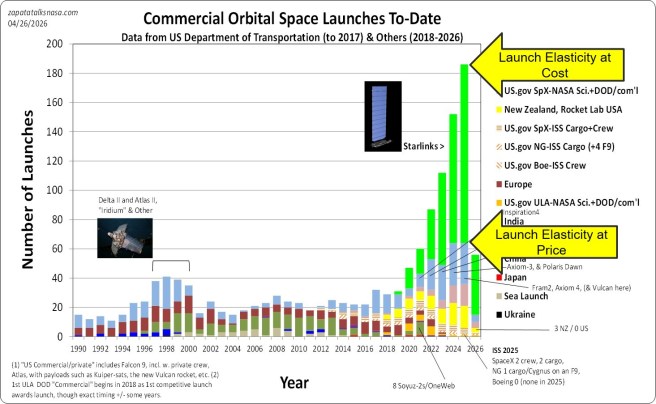
As yesterday’s SpaceX IPO wraps up and investors line up, it is worth remembering that SpaceX would probably not be around today if not for an initial NASA investment. The idea, then, was simple: who could take cargo to the International Space Station, not the old way, but as a service? The Shuttle program’s days were counted after all, and the follow-ups were going nowhere fast, or, in either case, focused on the Moon. If a new provider developed a very affordable rocket and spacecraft, they should be able to sell it to others, perhaps enough so that NASA became one of many customers. Everyone wins.

The program succeeded beyond its wildest dreams, and the rest is history. For good or for bad, the sci-fi-ish joke/dream from when data for the NASA budget chart was first being gathered decades ago has come true: the first trillionaire will make their fortune in space.
Yet, lightning must strike twice. NASA will, in this view, repeat its success investing in launch, this time investing in orbit. We will, we are driven to, expand human activity outward from Earth. If you have succeeded in creating a means to an end, a launcher serving NASA needs, and many others, and spurring new business cases like Starlink, Earth orbit is naturally next. The NASA Commercial Low-Earth-Orbit Destinations (CLD) program should also create a new means, private stations, spurring new business in medicine, materials, or what things may come. Everyone wins.
Yet there is a nagging reality – inflation. NASA first invested in the Commercial Cargo Program, which led to SpaceX in 2006. In the last 20 years, NASA’s budget has been whittled away by other programs with immediate needs, such as SLS and Orion, the ISS, lunar landers, spacesuits, and more.
If NASA, meaning Congress, is to invest effectively, for long-term successes beyond our wildest dreams, knowing the cards you are dealt is important. And knowing which cards are missing from the pack counts just as much.


